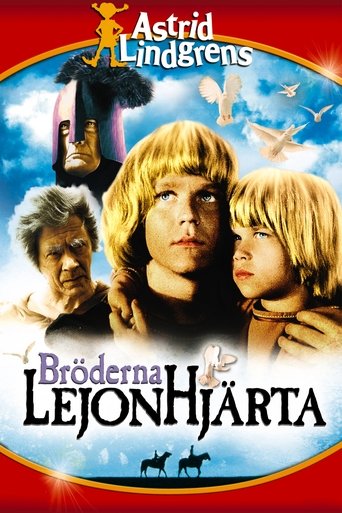
Los hermanos Corazón de León (1977)
Bröderna Lejonhjärta
Adaptación de la novela homónima de Astrid Lindgren (creadora de Pippi Calzaslargas). La historia es narrada por Karl Lejon, quien sufre una enfermedad terminal. Su hermano mayor Jonatan Lejon lo consuela hablándole de la existencia de Nangijala, un mundo después de la muerte. El libro (y la película) trata sobre las aventuras de Carlos y Juan en Nangijala, donde toman el apellido de Corazón de León y luchan por liberar ese mundo del malvado tirano Tengil, quien controla un ejército de ocupación y una gigantesca dragona, Katla. (FILMAFFINITY)
- Fecha de estreno
- 1977-09-23
- TMDB
- 6.7 / 10 (113)
- Duración
- 1 h 42 min
- Géneros
- Aventura, Fantasía, Familia
- Director
- Olle Hellbom
Reparto
- Staffan Götestam — Jonatan
- Lars Söderdahl — Skorpan
- Allan Edwall — Mattias
- Gunn Wållgren — Sofia
- Folke Hjort — Jossi
- Per Oscarsson — Orvar
- Tommy Johnson — Hubert
- Jan Nygren — Veder
- Micha Gabay — Kader
- Georg Årlin — Tengil
- Bertil Norström — Pjuke
- Mats Andersson — Tengil's Soldier 1
Curiosidades
- Basada en: Los hermanos Corazón de León
- Rodada en: Tomelilla, Estocolmo, Österlen, Aarhus, Dinamarca e Islandia
- Premios: 2 · Nominaciones: 0. Incluyendo: Guldbagge Award for Best Director; Greta
The Brothers Lionheart is a Swedish fantasy film which was released to cinemas in Sweden on 23 September 1977, directed by Olle Hellbom and based on the 1973 book of the same name, written by Astrid Lindgren. It won Sweden's Guldbagge Award for Best Director in 1978.
Production
The film was shot in Sweden, Denmark and Iceland. Filming locations included Stockholm for studio interiors and the openings sequence, while Skåne County in Sweden and Århus in Jutland represented Nangijala, while Þingvellir and Dimmuborgir in Iceland represented the lands of Tengil.
Upon release, unique for adaptations of Lindgren's work, it was given an 11 certificate by the Swedish board of censors, causing the Riksdag to enact an age limit of 7 and above for future films. The film nevertheless maintained the age limit of 11 and above for years until a 7 limit, called "Lex Lejonhjärta", was deemed acceptable.
The source work is widely considered, although the violent content is much toned down on screen, the most political and violent of Lindgren's books, involving themes of dictatorship, occupation, treason, democide, war, suicide and forced labour of nigh-Holocaustian reminiscence. Most of the named characters do not survive the film (although its setting in concurrent realities soften this fact).
Nevertheless, it has maintained its place as one of the most beloved and iconic adaptations, and films overall, although several technical aspects, such as the Katla model, are considered well out of date, and several lines from the film are widely culturally understood and in widespread use, such as "All power to Tengil, our liberator!" (in original Swedish: All makt åt Tengil, vår befriare!), a truism (used ironically out of context) pronounced…
Leer en Wikipedia · Texto de Wikipedia, CC BY-SA 4.0. Datos de Wikidata.
Recomendadas
- Wish Upon a Unicorn 2020 · ★ 6.9
- Las crónicas de Narnia: El león, la bruja y el armario 2005 · ★ 7.1
- Perdido en la montaña 2024 · ★ 7.1
- Un monstruo viene a verme 2016 · ★ 7.3
- El hogar de Miss Peregrine para niños peculiares 2016 · ★ 6.8
- Ronia: The Robber's Daughter 1984 · ★ 7.0
- La reina de las nieves 2002 · ★ 6.1
- El señor de los anillos: Las dos torres 2002 · ★ 8.4
- Discovering Dinotopia 2002 · ★ 6.4
- La última cazadora de dragones 2016 · ★ 5.9
- Aquaman y el reino perdido 2023 · ★ 6.5
- El secreto de los hermanos Grimm 2005 · ★ 5.9