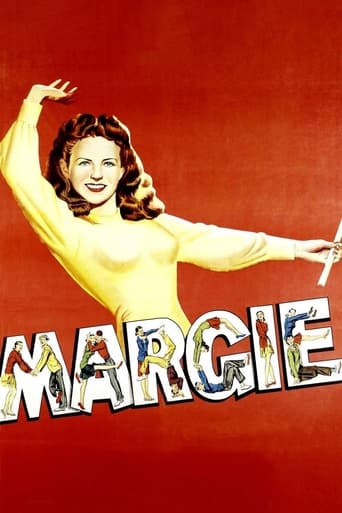
Margie (1946)
These were the days... When youth was flaming and the Charleston was the National Anthem.
A woman reminisces about her teenage years in the 1920s, when she fell in love with her teacher.
- Date of release
- 1946-10-15
- TMDB
- 7.1 / 10 (9)
- Runtime
- 1h 34m
- Genres
- Comedy, Romance
- Director
- Henry King
Casting
- Jeanne Crain — Marjorie "Margie" MacDuff
- Glenn Langan — Prof. Ralph Fontayne
- Lynn Bari — Miss Isabel Palmer
- Alan Young — Roy Hornsdale
- Barbara Lawrence — Marybelle Tenor
- Conrad Janis — Johnny "Johnikins" Green
- Esther Dale — Grandma McSweeney
- Hobart Cavanaugh — Mr. Angus MacDuff
- Ann E. Todd — Joyce Fontayne
- Hattie McDaniel — Cynthia
- Gurney Bell — Off-Screen Singer (voice) (uncredited)
- Vanessa Brown — Wanda (uncredited)
Interesting facts
Margie is a 1946 American romantic comedy film in Technicolor, directed by Henry King and starring Jeanne Crain, about a high school girl in the 1920s who develops a crush on her French teacher. Margie was a box-office hit, ranking in the top 15 highest-grossing films of the year, and established Crain as an important Fox star. Although not a true movie musical, it is sometimes classified with musicals for the large number of 1920s-era popular songs incorporated as nostalgic background in the film.
Production
In January 1945, 20th Century Fox paid $12,500 for a story written by Ruth McKenney and her husband Richard Bransten. For the screenplay adaption, F. Hugh Herbert used elements from the film Girls' Dormitory (1936).
The male lead was initially offered to Cornel Wilde, but he refused it and was put on suspension by the studio. Next, Richard Jaeckel was announced as the male lead, but he was eventually replaced by Glenn Langan.
This film marks the screen debut of Alan Young, who had been acting on radio since 1944.
Set decorations include the 1794 Thomas Lawrence painting, Pinkie, which can be seen in the home of Margie and her grandmother, located on the wall in the sitting room.
The film was shot in Reno, Nevada. The exteriors of "Central High" are actually the University of Nevada, Reno. In some shots, the snow-covered Sierras can be seen. This film is considered an excellent example of the Technicolor film process.
Read on Wikipedia · Text from Wikipedia, CC BY-SA 4.0. Data from Wikidata.
Recommended
- Date with Love 2016 · ★ 6.3
- Prom Pact 2023 · ★ 7.2
- A Cinderella Story 2004 · ★ 6.6
- She's All That 1999 · ★ 6.3
- The Rewrite 2014 · ★ 6.0
- Made of Honor 2008 · ★ 6.5
- The Trouble with Angels 1966 · ★ 6.7
- Singin' in the Rain 1952 · ★ 8.1
- What's Love Got to Do with It? 2023 · ★ 6.1
- Romy and Michele's High School Reunion 1997 · ★ 6.3
- Time Freak 2018 · ★ 6.7
- The Farmer's Daughter 1947 · ★ 7.2