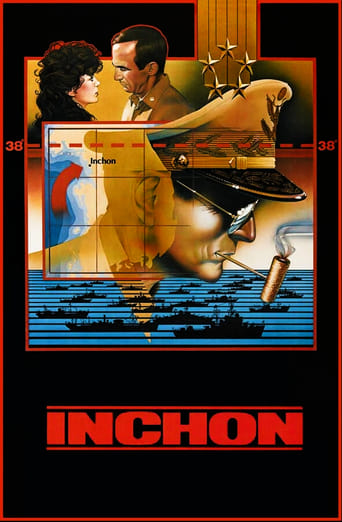
Inchon (1981)
Gen. Douglas MacArthur leads a Korean War campaign, and the war tests a married couple's relationship.
- Fecha de estreno
- 1981-05-04
- TMDB
- 3.9 / 10 (15)
- Duración
- 2 h 20 min
- Géneros
- Historia, Bélica, Drama
- Director
- Terence Young
Reparto
- Laurence Olivier — Gen. Douglas MacArthur
- Jacqueline Bisset — Barbara Hallsworth
- Ben Gazzara — Maj. Frank Hallsworth
- Toshirō Mifune — Saito-San
- Richard Roundtree — Sgt. Augustus Henderson
- David Janssen — David Feld
- 남궁원 — Park
- Gabriele Ferzetti — Turkish Brigadier
- Rex Reed — Longfellow
- Sabine Sun — Marguerite
- Dorothy James — Jean MacArthur
- Karen Kahn — Lim
Curiosidades
- Rodada en: Corea del Sur
- Premios: 4 · Nominaciones: 5. Incluyendo: Anexo:Razzie al peor actor; Anexo:Razzie a la peor película; Anexo:Razzie al peor director; Golden Raspberry Award for Worst Screenplay
Inchon is a 1981 war film about the Battle of Inchon, considered to be the turning point of the Korean War. Directed by Terence Young and financed by Unification movement founder Sun Myung Moon, the film stars Laurence Olivier as General Douglas MacArthur, who planned the surprise amphibious landing at Incheon, South Korea, in 1950, with Jacqueline Bisset, Ben Gazzara, Toshiro Mifune and Richard Roundtree.
Production
Sun Myung Moon formed One Way Productions in 1974, with Japanese newspaper publisher Mitsuharu Ishii as its head. Before deciding on making a war film, Moon and Ishii considered making biopics of Jesus or Elvis Presley. In 1978, psychic Jeane Dixon was consulted to communicate with the spirit of General Douglas MacArthur, and Dixon said that MacArthur's spirit endorsed the production of the film.
Inchon was financed by Moon and Ishii. Moon was involved with the film's production from the very beginning. Ishii, a member of the Unification movement in Japan and a friend of Moon, served as the film's producer; and Moon, although credited as "Special Advisor on Korean Matters", contributed $30 million to One Way Productions.
Ishii said he was a member of the Unification movement "just like a Catholic is a member of the Catholic Church and I believe Rev. Moon is very sincere about doing the Lord's work". Ishii was president of the World Daily News, which is published by Moon's media conglomerate News World Communications which also published other newspapers, including The Washington Times in the United States.
Inchon was initially budgeted at $18 million, but cost $46 million to produce. Attempts to solicit funding from Japanese banks fell through, and so the entire project was funded by Moon and the Unification Church.
In his book Encyclopedic Handbook of Cults in America, author and scholar of religion J. Gordon Melton noted that "Moon has attempted to project his ideas into all areas of American society" and cited Inchon as an example. Moon later said in a talk to movement members: "Why did we put so much effort into the movie Inchon? No matter what the result the motivation was for people to understand about MacArthur.
Leer en Wikipedia · Texto de Wikipedia, CC BY-SA 4.0. Datos de Wikidata.
Recomendadas
- Devotion. Una historia de héroes 2022 · ★ 7.0
- Emperador 2012 · ★ 6.2
- Escarlata y negro 1983 · ★ 7.1
- El juicio del motín del Caine 2023 · ★ 6.7
- Flyboys: Héroes del aire 2006 · ★ 6.5
- Rebelión en Polonia (Sublevación en el Gueto) 2001 · ★ 6.6
- Mr. Turner 2014 · ★ 6.6
- La batalla de Midway 1976 · ★ 6.6
- El día más largo 1962 · ★ 7.6
- Young Washington 2026 · ★ 7.7
- El arma del engaño 2022 · ★ 6.5
- No eran imprescindibles 1945 · ★ 6.5