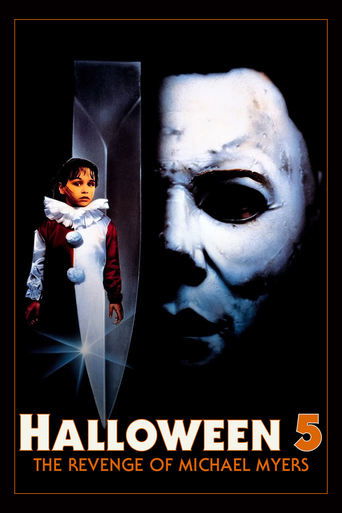
Halloween 5: The Revenge of Michael Myers (1989)
Michael still lives... and he's out for his revenge.
After lying in a coma for a year, Michael Myers awakens and stalks his way back to his small hometown in Illinois, intent on killing his niece, Jamie, who has been confined to a mental institution since his last attempt to slay her.
- Date of release
- 1989-10-12
- TMDB
- 5.3 / 10 (1418)
- Runtime
- 1h 38m
- Genres
- Horror, Thriller
- Director
- Dominique Othenin-Girard
- Collection
- Halloween Collection
Casting
- Danielle Harris — Jamie Lloyd
- Donald Pleasence — Dr. Sam Loomis
- Ellie Cornell — Rachel Carruthers
- Wendy Foxworth — Tina Williams
- Beau Starr — Sheriff Meeker
- Don Shanks — Michael Myers
- Jeffrey Landman — Billy Hill
- Tamara Glynn — Samantha Thomas
- Matthew Walker — Spitz
- Betty Carvalho — Nurse Patsey
- Troy Evans — Deputy Charlie
- Frankie Como — Deputy Nick Ross
Interesting facts
- Box office: $11.6M
- Filmed in: Utah
Halloween 5: The Revenge of Michael Myers is a 1989 American slasher film co-written and directed by Dominique Othenin-Girard, and starring Donald Pleasence, Danielle Harris, Ellie Cornell, Beau Starr, Wendy Kaplan, and Tamara Glynn. It is the sequel to Halloween 4: The Return of Michael Myers (1988) and the fifth installment in the Halloween series. The story follows serial killer Michael Myers who again returns to the town of Haddonfield to murder his traumatized niece, Jamie Lloyd, with whom he now shares a telepathic connection.
Production
Development on a fifth Halloween was fast tracked to meet a pre-set release deadline of October 1989. Producer Moustapha Akkad turned to Halloween 4: The Return of Michael Myers writer and director Alan B. McElroy and Dwight H. Little to return for their respective duties on the fifth film, however both declined.
After being instated as director, he infamously threw Bitterman's draft into a trashcan in front of Akkad. He brought in Robert Harders, of Home Movies, to write an entirely new draft, which saw a Frankenstein inspired story where Myers is resurrected and no longer evil but is pursued by an angry mob. Harders's pitch was rejected, leading Othenin-Girard to pitch a new concept with co-writer Michael Jacobs.
Another departure from previous films in the series was Othenin-Girard's attempt to persuade the audience to relate to the Michael Myers character, whom he intended to appear "more human [...] even vulnerable, with contradicting feelings inside of him." He illustrated these feelings with a scene where Michael removes his mask and sheds a tear. Girard explains, "Again, to humanize him, to give him a tear.
In the original closing scene, after Jamie finds that Michael has escaped from the police station, she is approached by a black-cloaked figure. At the time of filming, it was unknown who this figure was. It would only be expanded on and explained in the subsequent film, Halloween: The Curse of Michael Myers (1995), and the scene in question was attached to the beginning of the Producer's Cut of that film as a flashback.
I created the [Man in Black] character without knowing his exact origin. I considered him a soul brother to Michael who came from afar to get to him. I was conscious enough to give freedom of interpretation to the next team of creators as to who he really is. I was attentive not to lock them in too tight of a position, so they could play that card as they wished.
Read on Wikipedia · Text from Wikipedia, CC BY-SA 4.0. Data from Wikidata.
Recommended
- Halloween 4: The Return of Michael Myers 1988 · ★ 6.2
- Halloween 2018 · ★ 6.6
- Halloween II 1981 · ★ 6.6
- The Town That Dreaded Sundown 2014 · ★ 5.9
- Trick 2019 · ★ 5.9
- Jason Lives - Friday the 13th Part VI 1986 · ★ 6.3
- Freddy vs. Jason 2003 · ★ 6.1
- The Jester 2 2025 · ★ 6.9
- Bloodline Killer 2024 · ★ 5.9
- Poltergeist II: The Other Side 1986 · ★ 6.0
- Halloween Ends 2022 · ★ 6.0
- Insidious: The Last Key 2018 · ★ 6.3