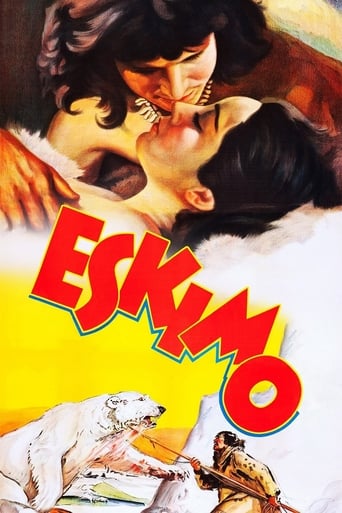
Eskimo (1933)
La feliz vida de un esquimal cambia desastrosamente cuando se conecta con un comerciante blanco sin escrúpulos.
- Fecha de estreno
- 1933-11-14
- TMDB
- 6.6 / 10 (15)
- Duración
- 1 h 57 min
- Géneros
- Drama, Acción, Aventura
- Director
- W.S. Van Dyke
Reparto
- Edgar Dearing — Constable Balk (uncredited)
- Peter Freuchen — Captain (uncredited)
- Edward Hearn — Captain's Mate (uncredited)
- Lotus Long — Iva (uncredited)
- Mala — Mala, aka Kripik (uncredited)
- Joe Sawyer — Sergeant Hunt (uncredited)
- W.S. Van Dyke — Inspector White (uncredited)
- Lulu Wong — Aba, Mala's first wife (uncredited)
Curiosidades
- Premios: 2 · Nominaciones: 1. Incluyendo: Óscar al mejor montaje; National Board of Review a las 10 Películas más Destacadas
Eskimo is a 1933 American pre-Code drama film directed by W. S. Van Dyke and released by Metro-Goldwyn-Mayer (MGM). It is based on the books Der Eskimo and Die Flucht ins weisse Land by Danish explorer and author Peter Freuchen. The film stars Ray Mala as Mala, Lulu Wong Wing as Mala's first wife Aba, Lotus Long as Mala's second wife Iva, Peter Freuchen as the Ship Captain, W. S. Van Dyke as Inspector White, and Joseph Sauers as Sergeant Hunt.
Production
The script for Eskimo was based on books by Danish explorer and author Peter Freuchen. W.S. Van Dyke was assigned by MGM to direct, but it was not a film which Van Dyke was interested in doing. He wrote to his uncle, John Charles Van Dyke, on May 24, 1932, "Am going to film Peter Freuchen's book Eskimo. Don't fancy the job a damn bit, but it brings in the bread and butter."
Van Dyke intended the picture to depict the corrupting influence white culture had on the Eskimos, much as he had done in White Shadows in the South Seas. The script originally ended with Mala and Iva escaping onto the ice, only to drown. But producer Hunt Stromberg felt this ending was too downbeat, and changed it in April 1932 to the ending now seen on film.
Both Stromberg and Van Dyke wanted the Native Alaskans in the film to speak in their native tongue. However, MGM production chief Irving Thalberg worried that intertitles were too distracting and would seem old-fashioned, and Stromberg agreed. By this time, however, it was September 1932.
Stromberg demanded complete authenticity in casting, language, and the depiction of Eskimo life. Casting was critical. Van Dyke cast Inupiat natives (most of them from Barrow, Alaska) for all the minor roles, but Stromberg was so insistent on finding the perfect male lead that casting the title role of Mala/Kripik proved difficult.
According to Peter Freuchen, MGM considered filming in Greenland, where Freuchen's novels were set. But the difficult weather and bright summer light (which made filming difficult) dissuaded them, and the production settled on Alaska instead. Freuchen accompanied the production not only as an actor, but as an interpreter as well.
Leer en Wikipedia · Texto de Wikipedia, CC BY-SA 4.0. Datos de Wikidata.
Recomendadas
- Río salvaje 1994 · ★ 6.5
- Colmillo blanco 1991 · ★ 6.7
- La llamada de lo salvaje 2020 · ★ 7.5
- Togo 2019 · ★ 8.1
- El lobo y el león 2021 · ★ 7.5
- Balto: La leyenda del perro esquimal 1995 · ★ 7.3
- Twister 1996 · ★ 6.6
- Los dientes del diablo 1960 · ★ 6.9
- Dispara a matar 1988 · ★ 6.6
- El pacto 2011 · ★ 5.9
- El renacido 2015 · ★ 7.5
- Valor de ley 1969 · ★ 7.3