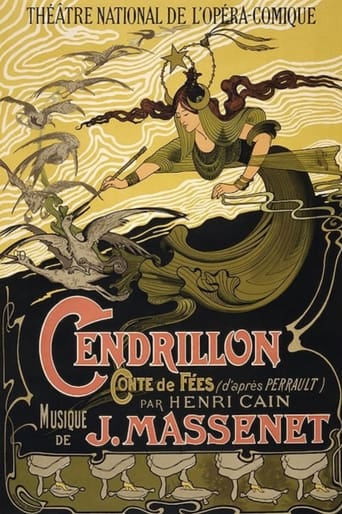
Cinderella (1899)
Cendrillon
A fairy godmother magically turns Cinderella's rags to a beautiful dress, and a pumpkin into a coach. Cinderella goes to the ball, where she meets the Prince - but will she remember to leave before the magic runs out? Méliès based the art direction on engravings by Gustave Doré. First known example of a fairy-tale adapted to film, and the first film to use dissolves to go from one scene to another.
- Date of release
- 1899-10-01
- TMDB
- 6.2 / 10 (131)
- Runtime
- 6m
- Genres
- Drama, Family, Fantasy, Romance
- Director
- Georges Méliès
Casting
- Georges Méliès — le gnome de la pendule / le suisse à l'entrée de l'église
- Bleuette Bernon — Marraine la bonne fée
- Carmelli — Le Prince Charmant
- Jehanne d'Alcy — La Reine Mère
- Dupeyron — Un invité à la fête
- Mlle Barral — Cendrillon
Interesting facts
- Based on: Cinderella
Cinderella is an 1899 French trick film directed by Georges Méliès, based on the fairy tale by Charles Perrault. It was released by Méliès's Star Film Company and is numbered 219–224 in its catalogues, where it is advertised as a grande féerie extraordinaire en 20 tableaux.
Production
Méliès modeled the film's visual style on the engravings of Gustave Doré, who had illustrated the story for an edition of Perrault's fairy tales. (Doré was stylistically influential across Méliès's career, especially in this film and in his film adaptations of four other works Doré had illustrated: Red Riding Hood, Blue Beard, The Wandering Jew, and Baron Munchausen's Dream.) The direct inspiration for the film of Cinderella was probably a stage…
Cinderella was Méliès's first film with multiple scenes (tableaux), using six distinct sets and five changes of scene within the film. (His catalogue, by dividing the action into smaller beats, lists twenty tableaux within the film, a generous numbering probably devised for publicity reasons.) So many extras were used in Cinderella that Méliès designated a Chief Extra to lead them.
Read on Wikipedia · Text from Wikipedia, CC BY-SA 4.0. Data from Wikidata.
Recommended
- Cinderella 2015 · ★ 6.8
- FairyTale: A True Story 1997 · ★ 6.4
- Cinderella II: Dreams Come True 2002 · ★ 6.1
- Cinderella III: A Twist in Time 2007 · ★ 6.6
- Happily Ever After 1989 · ★ 5.8
- Stardust 2007 · ★ 7.3
- The Princess and the Goblin 1991 · ★ 5.8
- The Little Mermaid 2023 · ★ 6.2
- Sofia the First: Once Upon a Princess 2012 · ★ 7.4
- Cinderella and the Secret Prince 2018 · ★ 6.5
- Descendants 2015 · ★ 7.2
- Beauty and the Beast: A 30th Celebration 2022 · ★ 6.8