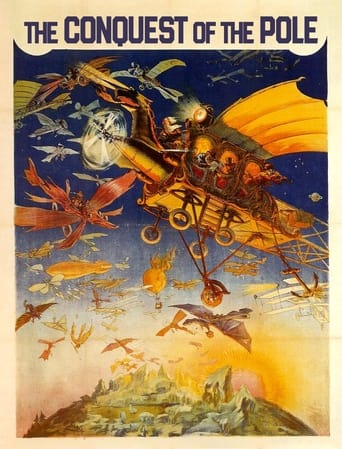
The Conquest of the Pole (1912)
À la conquête du pôle
A science fantasy film that deals with an extraordinary race to the north pole by rival parties of balloonists. Based on the novel "The Adventures of Captain Hatteras" by Jules Verne.
- Date of release
- 1912-05-03
- TMDB
- 6.2 / 10 (53)
- Runtime
- 33m
- Genres
- Adventure, Comedy, Science Fiction
- Director
- Georges Méliès
Casting
- Georges Méliès — Le professeur Mabouloff
- Fernande Albany
Interesting facts
- Based on: The Adventures of Captain Hatteras
The Conquest of the Pole is a 1912 French silent science fantasy trick film directed by and starring Georges Méliès. The film, loosely inspired by contemporary events and by Jules Verne's Voyages Extraordinaires, follows the comic misadventures of an international group of explorers on an expedition to the North Pole, where they encounter a man-eating frost giant and a dangerous magnetic needle.
Production
Georges Méliès is widely regarded as the first person to recognize the potential of narrative film, and his A Trip to the Moon (1902), The Kingdom of the Fairies (1903), and The Impossible Voyage (1904) were among the most popular films of the first few years of the twentieth century. However, by the time of The Conquest of the Pole his fortunes were in decline.
The Conquest of the Pole is Méliès's longest cinematic work: 650 meters of film, which, at his preferred projection speed of 12 to 14 frames per second, is about 44 minutes. It was also the last of Méliès's "journey" films, a genre that comprises some of his most significant works, such as A Trip to the Moon and The Impossible Voyage.
During his career, Méliès had built two glass-and-metal film studios in Montreuil, Seine-Saint-Denis. The first one was relatively small, with a stage measuring 16 by 13 feet. The second one, Studio B, was built in 1905 with considerably larger dimensions, including a stage about thirty feet wide and an elevator crane allowing large objects to be carried up and down.
Most of the film is shot in Méliès's usual style, in which a stationary camera allows the viewer to watch the film as if it were being played in scenes on a theatre stage. However, the scene in which the airplane lands in the Arctic is notable for an advanced editing technique in which the point of view becomes mobile rather than stationary.
Read on Wikipedia · Text from Wikipedia, CC BY-SA 4.0. Data from Wikidata.
Recommended
- Real Men 1987 · ★ 6.0
- The Willoughbys 2020 · ★ 7.1
- Secret Society of Second-Born Royals 2020 · ★ 6.6
- Cars Toon Mater's Tall Tales 2008 · ★ 7.1
- Arctic Dogs 2019 · ★ 5.9
- Afterburn 2025 · ★ 6.2
- Chickenhare and the Hamster of Darkness 2022 · ★ 7.2
- Survive 2024 · ★ 5.9
- Stewie Griffin: The Untold Story 2005 · ★ 6.9
- Scrat: Spaced Out 2016 · ★ 6.3
- Slumberland 2022 · ★ 7.2
- Sketch 2025 · ★ 7.0