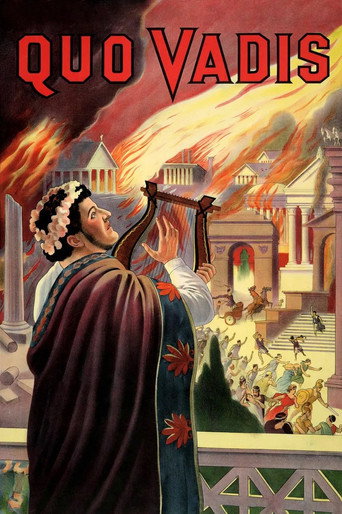
Quo Vadis? (1913)
During the latter years of the reign of the tyrannical Roman emperor Nero, Marcus Vinicius, one of Nero's officers, falls in love with a young Christian named Lygia, attempting to enslave her. Lygia's protector, the noble and burly Ursus, works to save her from Vinicius' clutches. Pursuing Lygia, Vinicius finds himself at a catacomb prayer meeting led by the apostle Peter and finds his conscience stirring-- just as Nero orders Rome burned. A landmark in epic film, Enrico Guazzoni’s grand-scale masterpiece laid the foundations for what colossal Italian spectacles would become. The film had tremendous influence on Giovanni Pastrone’s Cabiria (1914) and D.W. Griffith’s Intolerance (1916).
- Date de sortie
- 1913-03-01
- TMDB
- 5.7 / 10 (24)
- Durée
- 1 h 34 min
- Genres
- Drame, Histoire
- Réalisateur
- Enrico Guazzoni
Distribution
- Amleto Novelli — Vinicius
- Gustavo Serena — Petronius
- Bruto Castellani — Ursus
- Amelia Cattaneo — Eunice
- Carlo Cattaneo — Nero
- Lea Giunchi — Lygia
- Augusto Mastripietri — Chino
- Cesare Moltini — Tigellinus
- Olga Brandini — Poppaea
- Ignazio Lupi — Aulus
- Giovanni Gizzi — Saint Peter
- Lia Orlandini
Anecdotes
- Adapté de : Quo vadis ?
Quo vadis ? est un film italien réalisé par Enrico Guazzoni, sorti en 1913. Il s'agit de la troisième adaptation du roman du même nom de Henryk Sienkiewicz, qui valut à son auteur le prix Nobel de littérature en 1905. Projeté le 21 avril 1913 à l'Astor Theatre (en) à New York, le film est alors le plus long métrage jamais présenté aux États-Unis. Avant Cabiria, Quo vadis ? jette les principes du film historique à grand spectacle et impose les films de long métrage, ce qui en fait le premier des films modernes.
Lire sur Wikipédia · Texte de Wikipédia, CC BY-SA 4.0. Données de Wikidata.
Recommandés
- Le Signe de la croix 1932 · ★ 6.5
- Paul, Apôtre du Christ 2018 · ★ 7.6
- Barabbas 1961 · ★ 6.9
- Le Roi des rois 1961 · ★ 7.2
- François et le chemin du soleil 1972 · ★ 7.1
- Karol, l'homme qui devint Pape 2005 · ★ 7.0
- The Book of Daniel 2013 · ★ 7.0
- Les Onze Fioretti de François d'Assise 1950 · ★ 7.0
- La Tunique 1953 · ★ 6.8
- Vincere 2009 · ★ 6.7
- Esterno Notte - Prima Parte 2022 · ★ 7.8
- L'Affaire Mattei 1972 · ★ 7.5