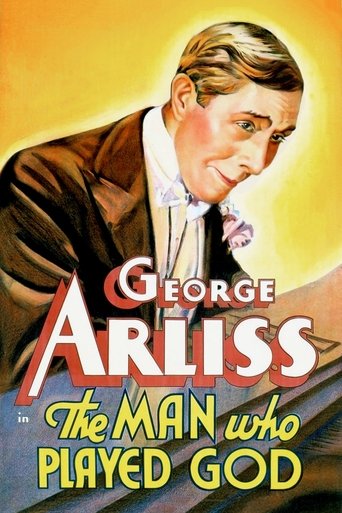
The Man Who Played God (1932)
'A Modern Drama From Real Life'
While giving a private performance for a visiting monarch, concert pianist Montgomery Royle is deafened when a bomb is detonated in an attempt to assassinate the foreign ruler. With his career over as a result of his injury, Royle returns to New York City with his sister Florence, close friend Mildred Miller, and considerably younger fiancée Grace Blair. After abandoning thoughts of suicide, Montgomery discovers he can lip read, and he spends his days observing people in Central Park from his apartment window. As he learns of people's problems, he tries to help them anonymously and becomes absorbed in his game of "playing God".
- Date of release
- 1932-02-09
- TMDB
- 7.2 / 10 (10)
- Runtime
- 1h 20m
- Genres
- Romance, Drama
- Director
- John G. Adolfi
Casting
- George Arliss — Montgomery Royle
- Violet Heming — Mildred Miller
- Bette Davis — Grace Blair
- André Luguet — The King
- Louise Closser Hale — Florence Royle
- Donald Cook — Harold Van Adam
- Ivan F. Simpson — Battle
- Oscar Apfel — Appleby - the Lip Reader
- Charles E. Evans — The Doctor
- Hedda Hopper — Mrs. Alice Chittendon
- Ray Milland — Eddie (uncredited)
- Dorothy Libaire — Jenny (uncredited)
Interesting facts
- Box office: $835K
- Budget: $237K
- Earned 3.5× its budget
The Man Who Played God is a 1932 American pre-Code drama film produced by Darryl F. Zanuck and directed by John G. Adolfi. George Arliss stars as a concert pianist embittered by the loss of his hearing, who eventually finds redemption by helping others; it also features a then little-known Bette Davis as the much younger woman engaged to the protagonist.
Production
Warners had made a silent version of The Man Who Played God in 1922, based on the 1914 play The Silent Voice by Jules Eckert Goodman, who adapted it from a story by Gouverneur Morris published in Cosmopolitan. For the 1932 film, a fresh adaptation was reworked by Julien Josephson and Maude T. Howell. Arliss also made some contributions to the screenplay for which he was paid, though not credited.
In September 1931, disappointed with the way her Hollywood career had failed to progress, Bette Davis was packing to return to New York City when George Arliss called and invited her to discuss the role of Grace Blair with him. Certain the caller was a prankster, Davis later recalled, "I replied in an imitative English accent" and told him "Of course, Mr. Arliss. How jolly decent of you".
At age sixty-three, more than ten years older than the character, Arliss knew he was too old for the role and was concerned the age difference between him and the actress cast as Grace Blair would be ridiculous, unless she were played by someone who could convey both love and hero worship for his character. After interviewing many young women, he felt Davis was the one most capable of handling the part.
After seeing a rough cut of the film, Jack L. Warner signed Davis to a five-year contract, starting at $400 per week. She would remain with Warner Bros. for the next eighteen years, and Davis was beholden to Arliss for the rest of her life, crediting him for "the career that finally emerged". Of Davis, Arliss wrote in his 1940 biography, My Ten Years in the Studios, "I did not expect anything except a nice little performance.
Classical music performed in the film includes Fantaisie-Impromptu by Frédéric Chopin, Moonlight Sonata by Ludwig van Beethoven, and Onward, Christian Soldiers by Arthur Sullivan.
Read on Wikipedia · Text from Wikipedia, CC BY-SA 4.0. Data from Wikidata.
Recommended
- New York, New York 1977 · ★ 6.5
- High Strung Free Dance 2018 · ★ 7.3
- Goodbye Again 1961 · ★ 7.1
- The Disappearance of Eleanor Rigby: Him 2014 · ★ 6.7
- Rent 2005 · ★ 6.8
- Permanent Vacation 1981 · ★ 5.9
- Intermezzo: A Love Story 1939 · ★ 6.7
- Falling in Love 1984 · ★ 6.6
- Like Sunday, Like Rain 2014 · ★ 7.3
- The Lost Husband 2020 · ★ 6.6
- Bad Girl 1931 · ★ 6.0
- An Affair to Remember 1957 · ★ 7.4