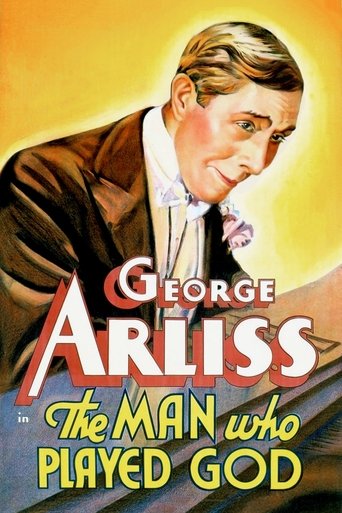
The Man Who Played God (1932)
While giving a private performance for a visiting monarch, concert pianist Montgomery Royle is deafened when a bomb is detonated in an attempt to assassinate the foreign ruler. With his career over as a result of his injury, Royle returns to New York City with his sister Florence, close friend Mildred Miller, and considerably younger fiancée Grace Blair. After abandoning thoughts of suicide, Montgomery discovers he can lip read, and he spends his days observing people in Central Park from his apartment window. As he learns of people's problems, he tries to help them anonymously and becomes absorbed in his game of "playing God".
- Data di uscita
- 1932-02-09
- TMDB
- 7.2 / 10 (10)
- Durata
- 1 h 20 min
- Generi
- Romance, Dramma
- Regista
- John G. Adolfi
Cast
- George Arliss — Montgomery Royle
- Violet Heming — Mildred Miller
- Bette Davis — Grace Blair
- André Luguet — The King
- Louise Closser Hale — Florence Royle
- Donald Cook — Harold Van Adam
- Ivan F. Simpson — Battle
- Oscar Apfel — Appleby - the Lip Reader
- Charles E. Evans — The Doctor
- Hedda Hopper — Mrs. Alice Chittendon
- Ray Milland — Eddie (uncredited)
- Dorothy Libaire — Jenny (uncredited)
Curiosità
- Incassi: 835K USD
- Budget: 237K USD
- Ha incassato 3,5× il suo budget
The Man Who Played God è un film del 1932 diretto da John G. Adolfi. La sceneggiatura è di Julien Josephson e Maude T. Howell ed è basata su un lavoro del 1914 The Silent Voice di Jules Eckert Goodman, adattamento di un racconto di Gouverneur Morris. Fu il film che lanciò definitivamente la carriera di Bette Davis, una delle più grandi stelle della storia del cinema ma che ai tempi, dopo due anni di ruoli minori e provini falliti era quasi rassegnata a tornare a calcare i teatri di New York; per il resto della sua vita Davis accreditò George Arliss, che aveva insistito per averla a suo fianco, come colui che contribuì alla fine del periodo di “pausa” della sua carriera.
Produzione
Le riprese del film, prodotto dalla Warner Bros., iniziarono il 30 novembre 1931 negli studi Warner di Burbank, al 4000 del Warner Boulevard. Il direttore della Vitaphone Orchestra era il maestro Leo F. Forbstein, mentre il pianista era Salvatore Santaella (non accreditato).
Leggi su Wikipedia · Testo da Wikipedia, CC BY-SA 4.0. Dati da Wikidata.
Consigliati
- New York, New York 1977 · ★ 6.5
- New York Academy - Freedance 2018 · ★ 7.3
- La scomparsa di Eleanor Rigby - Lui 2014 · ★ 6.7
- Le piace Brahms? 1961 · ★ 7.1
- Intermezzo 1939 · ★ 6.7
- Rent 2005 · ★ 6.8
- Permanent Vacation 1981 · ★ 5.9
- Il colore nascosto delle cose 2017 · ★ 6.3
- Innamorarsi 1984 · ★ 6.6
- Like Sunday, Like Rain 2014 · ★ 7.3
- La vita all’improvviso 2020 · ★ 6.6
- La notte 1961 · ★ 7.9