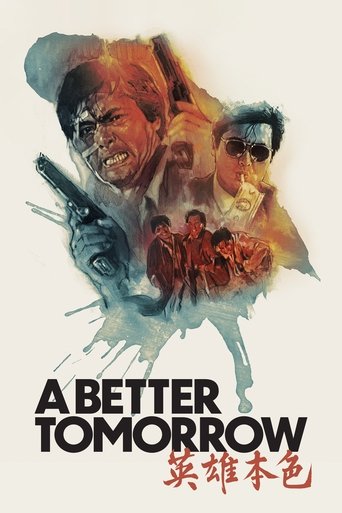
A Better Tomorrow (1986)
英雄本色
Brothers by blood. Enemies by chance. Killers by nature.
A reforming ex-gangster tries to reconcile with his estranged policeman brother, but the ties to his former gang are difficult to break.
- Date of release
- 1986-08-02
- TMDB
- 7.4 / 10 (666)
- Runtime
- 1h 35m
- Genres
- Action, Crime, Drama
- Director
- John Woo
- Collection
- A Better Tomorrow Collection
Casting
- Ti Lung — Sung Chi Ho
- Chow Yun-Fat — Mark Lee
- Leslie Cheung Kwok-wing — Sung Chi Kit
- Emily Chu Bo-yee — Jackie
- Waise Lee Chi-hung — Shing
- Tien Feng — Mr. Sung
- John Woo — Inspector Wu
- Sek Yin-Tsi — Mr. Yiu
- Kenneth Tsang — Kin
- Wang Hsieh — Boss Wang
- Leung Ming — Uncle Chan
- Chan Chi-Fai — Boss Wang's Nephew
Interesting facts
- Awards: 1 · Nominations: 0. Including: Hong Kong Film Award for Best Film
A Better Tomorrow is a 1986 Hong Kong action film directed and produced by John Woo, with a screenplay by Woo, Chan Hing-ka, and Leung Suk-wah. The film stars Ti Lung, Leslie Cheung, Chow Yun-fat, Emily Chu, and Waise Lee. Ti plays Ho, a triad gangster and money counterfeiter who is sent to prison after being betrayed by his subordinate, Shing (Lee). After his release, Ho tries to reform himself and reconcile with his estranged brother Kit (Cheung), a police officer who resents him for his criminal past. Ho becomes torn between trying and failing to make amends with Kit, and following the advice of his friend Mark (Chow) to seek revenge for Shing's treachery.
Production
The primary inspiration for A Better Tomorrow was Patrick Lung's The Story of a Discharged Prisoner (1967), a film which John Woo and Tsui Hark both greatly admired. According to film critic Law Kar, Woo had witnessed Lung directing the movie at Wader Film Studio; Tsui meanwhile, had seen it as a teenager and was impressed by the film's handling of social issues.
Undeterred by the rejection, Tsui founded the production company Film Workshop in April 1984 with his wife, Nansun Shi. Tsui then approached his friend Woo, who had helped kickstart his directing career by getting him initial contract work with Cinema City, to come write and direct a gangster film. Woo himself had been feeling burnt out while working in Taiwan for Cinema City.
Inspired by Jean-Pierre Melville, Woo began writing A Better Tomorrow with the goal of making it his own version of Le Samouraï (1967). Encouraged by Tsui to draw upon his own personal experiences to write the film's dialogue, Woo considered A Better Tomorrow to be his first auteur movie. He meant for the film to be a way for him to express his feelings about Hong Kong and human dignity, and didn't intend for it to be a political statement.
Woo was influenced by the gallant tales of wuxia, remarking that films like A Better Tomorrow "are violent, but they also have an element of romance—not love, but chivalry—and there's always the dream of a better world." He noted the impact that a previous directorial effort, Last Hurrah for Chivalry (1979), had on him, calling it a prequel to A Better Tomorrow.
In addition to Woo, Chan Hing-ka and Leung Suk-wah (梁淑華) also received writing credits for the screenplay. Chan was enlisted by one of the film's production managers, who remembered his work co-writing the TVB television series The Battle Among the Clans (1985). His primary screenplay contribution was introducing a romantic relationship between Kit and Jackie, as Woo and Tsui wanted the younger characters in the film to get more screen time.
Read on Wikipedia · Text from Wikipedia, CC BY-SA 4.0. Data from Wikidata.
Recommended
- A Better Tomorrow II 1987 · ★ 7.1
- The White Storm 2013 · ★ 6.4
- Dragged Across Concrete 2019 · ★ 6.6
- New Police Story 2004 · ★ 7.1
- Blood 2012 · ★ 5.9
- Gone in Sixty Seconds 2000 · ★ 6.5
- Special ID 2013 · ★ 6.0
- Scarface 1983 · ★ 8.2
- Infernal Affairs 2002 · ★ 7.8
- Before the Devil Knows You're Dead 2007 · ★ 7.1
- Lethal Weapon 4 1998 · ★ 6.6
- The Client 1994 · ★ 6.7