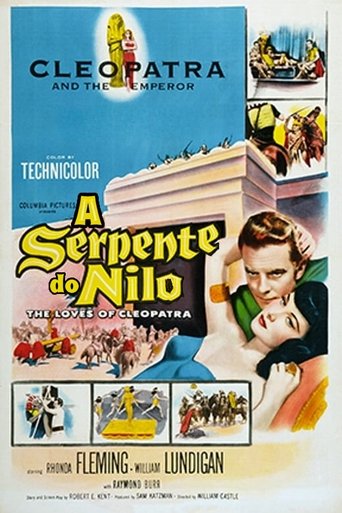
A Serpente do Nilo (1953)
Serpent of the Nile
Sam Katzman usou suas habilidades neste filme de baixo orçamento para levar às telas o conto de Cleópatra e Marco Antonio, que certamente não pode se comparar com produções maiores, mas tem algo para ser admirado pelo que foram capazes de fazer. O filme centra-se em Cleópatra (Rhonda Fleming), que é amada por Marco Antonio (Raymond Burr), mas está interessada em Lucílio (William Lundigan), um homem que logo começa a pensar que ela não é a melhor coisa para o Egito.
- Data de estreia
- 1953-05-08
- TMDB
- 7.2 / 10 (6)
- Duração
- 1 h 21 min
- Géneros
- História, Aventura
- Realizador
- William Castle
Elenco
- Rhonda Fleming — Cleopatra
- William Lundigan — Lucilius
- Raymond Burr — Mark Antony
- Jean Byron — Charmian
- Michael Ansara — Captain Florus
- Michael Fox — Octavius
- Conrad Wolfe — Elderly Assassin
- John Crawford — Captain Domitius
- Jane Easton — Cytheris
- Robert Griffin — Brutus
- Frederic Berest — Marculius
- Julie Newmar — The Gilded Girl (as Julie Newmeyer)
Curiosidades
Serpent of the Nile is a 1953 American Technicolor historical adventure film produced by Sam Katzman and directed by William Castle. The film starred Rhonda Fleming, Raymond Burr, William Lundigan, and Michael Ansara. In an early role, actress Julie Newmar appears as an exotic dancer clad only in gold paint. It also stars William Lundigan as Lucilius and Michael Fox as Octavius.
Production
In November 1951 Katzman announced he would make the movie based on Cleopatra by H. Rider Haggard. It was part of an eight-film slate he was making at Columbia, others including Prince of Pirates with Paul Henreid, Slaves of Babylon, Cairo to Suez, Jack McCall, Desperado, The Pathfinder, Siren of Bagdad, and Flame of Calcutta.
In May 1952 Katzman said the film would start in August. It was not made until 1953, when it was William Castle's first film at Columbia after a number of years at Universal. According to Castle, Katzman told the director this was Katzman's most ambitious film to date. Castle says the film was sold to the public as "2 years in the making" when Katzman had in reality only been talking about making it for two years.
The title was apparently adapted from Shakespeare's Antony and Cleopatra, Act I, scene 5.
The film had a very low budget. It was shot on the sets left over from Rita Hayworth's Salome. One sequence depicts a chariot racing through the sands of Egypt towards a sand dune in the distance, behind which looms a pyramid. It is extremely obvious that this composition (like many others) is a matte shot: the pyramid in the background is a superimposed painting, with the sand dune concealing the join between the live action and the matte.
Ler na Wikipédia · Texto da Wikipédia, CC BY-SA 4.0. Dados do Wikidata.
Recomendados
- Cleópatra 1963 · ★ 7.1
- Cleópatra 1934 · ★ 6.1
- César e Cleópatra 1946 · ★ 6.2
- Os Reis do Sol 1963 · ★ 6.2
- Demétrio, o Gladiador 1954 · ★ 6.6
- Ben-Hur: A Tale of the Christ 1925 · ★ 7.3
- Upsss 2! A Aventura Continua 2020 · ★ 7.6
- A Jóia do Nilo 1985 · ★ 6.2
- A Volta ao Mundo em Oitenta Dias 1956 · ★ 6.7
- Rainha do Deserto 2015 · ★ 5.8
- Davy Crockett and the River Pirates 1956 · ★ 6.3
- Espírito Livre 2023 · ★ 7.0