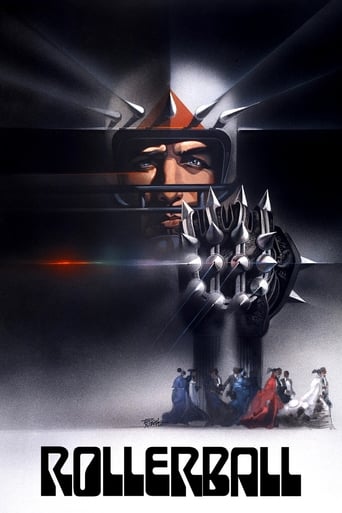
Rollerball (1975)
In the not-too-distant future, wars will no longer exist. But there WILL be...The Game
In a corporate-controlled future, an ultra-violent sport known as Rollerball represents the world, and one of its powerful athletes is out to defy those who want him out of the game.
- Date of release
- 1975-06-25
- TMDB
- 6.3 / 10 (664)
- Runtime
- 2h 5m
- Genres
- Science Fiction
- Director
- Norman Jewison
Casting
- James Caan — Jonathan E.
- John Houseman — Bartholomew
- Maud Adams — Ella
- John Beck — Moonpie
- Moses Gunn — Cletus
- Pamela Hensley — Mackie
- Barbara Trentham — Daphne
- Shane Rimmer — Rusty, Team Executive
- John Normington — Executive
- Burt Kwouk — Japanese Doctor
- Nancy Bleier — Girl in Library
- Richard LeParmentier — Bartholomew's Aide
Interesting facts
- Based on: Roller ball murder
- Filmed in: Germany, Munich, and Pinewood Studios
- Awards: 1 · Nominations: 0. Including: Saturn Award for Best Science Fiction Film
Rollerball is a 1975 American dystopian science-fiction sports film directed and produced by Norman Jewison, and starring James Caan, John Houseman, Maud Adams, John Beck, Moses Gunn and Ralph Richardson. The screenplay, written by William Harrison, adapted his own short story "Roller Ball Murder", which had first appeared in the September 1973 issue of Esquire.
Production
The film is based on a short story, entitled "Roller Ball Murder", published in Esquire, by novelist William Harrison, who joined the University of Arkansas English department in 1964 and established the Creative Writing Program. Norman Jewison bought the story and hired Harrison to co-write the screenplay with him (they shared an agent) and made a deal with United Artists.
Rollerball's arena sequences were shot at the Rudi-Sedlmayer-Halle in Munich, West Germany. This hall was selected because it was the only sports arena in the world with a near-circular profile, which the production could take over and re-dress for shooting. The track surface was designed by renowned track specialist Derek Timpson.
The then-new BMW Headquarters and Museum buildings in Munich appear as the headquarters buildings of the Energy Corporation at Olympiapark, Munich. The sequence where Jonathan E. visits Geneva to consult with Zero the supercomputer concerning corporate decisions uses exterior shots of the Palace of Nations. Scenes were also filmed at Fawley Power Station, near Southampton, England. The remainder of the film was shot at Pinewood Studios.
The film was shot in 35mm with a 1.85 aspect ratio but was released in some theaters in 70mm with a 2:1 aspect ratio.
As the titular sport was only referred to vaguely in Harrison's original short story, rollerball was created largely by Norman Jewison and his production designer John Box, who conceptualized it as a "blend of a roulette wheel and a pinball machine," combining elements of roller derby, hockey, football, motocross racing, and judo.
Read on Wikipedia · Text from Wikipedia, CC BY-SA 4.0. Data from Wikidata.
Recommended
- The Blood of Heroes 1989 · ★ 5.9
- Universal Soldier: The Return 1999 · ★ 5.9
- The Running Man 1987 · ★ 6.5
- Death Race 2000 1975 · ★ 6.1
- Boss Level 2021 · ★ 6.9
- The Zero Theorem 2013 · ★ 6.1
- eXistenZ 1999 · ★ 6.8
- Demolition Man 1993 · ★ 6.8
- Elysium 2013 · ★ 6.5
- Terminator 2: Judgment Day 1991 · ★ 8.2
- Death Race: Inferno 2013 · ★ 5.9
- Terminator: Dark Fate 2019 · ★ 6.4