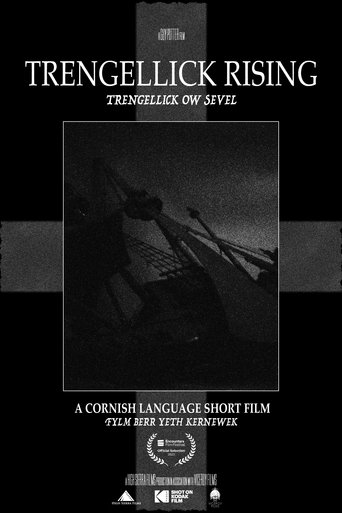
Trengellick Rising (2024)
A Cornish Language Short Film
Sentenced for a crime without trial, Private Gerren Pascoe is sent to a remote outpost to report on the movements of enemy ships. Isolated with only a surly and unhinged superior for company, the men descend into a maelstrom of chaos, debauchery and fear. The lines between right and wrong soon become blurred - as does the reality of why they're really there.
- Date of release
- 2024-01-17
- TMDB
- 9.0 / 10 (1)
- Runtime
- 29m
- Genres
- Adventure, History, Mystery
- Director
- Guy Potter
Casting
- Jeremy Manning — Jago Helghyer
- Guy Potter — Private Gerren Pascoe
- Zennor Rose — Persephone Cadieux
- Michael Fenner — Michael Fenner
Interesting facts
Trengellick Rising is a 2023 Cornish language short film written and directed by Guy Potter. The film was successfully funded via Kickstarter and has received support from Cornwall Council, Falmouth University and the Sound/Image Cinema Lab.
Production
Development of the film began in late 2019, with Guy Potter writing the script as a follow up to his micro-short Prey, a film created on assignment for Sundance Collab. Intending to expand on the format of Prey, it was decided that Trengellick Rising should also be shot on black and white 16mm film, and hand-processed in much the same way. This became an integral part of the Trengellick Rising production.
In March 2021, it was decided that the film be performed entirely in Kernewek, or the Cornish language. The script was translated by Cornwall Council and the Trengellick Rising fundraising page was launched on Kickstarter.
On 1 April 2021, Trengellick Rising was successfully financed through Kickstarter, achieving 145% of its target. The project raised £6,550 from 103 different pledges from all over the world.
Filming began in August 2021 in locations around Bodmin (including Jamaica Inn) as well as near the Hartland Heritage Coast. Filming on the project wrapped a few weeks later.
In October 2021, the director Guy Potter began to develop the footage by hand, in a makeshift darkroom at home. Mixing the chemicals and processing the film himself, he developed over 3,500 ft, over a kilometre of film negative. In an interview with BBC Cornwall, he described this as “the hardest part of the production so far” but that the resulting aesthetic was “scratchy, raw and rough around the edges, much like the story itself.”
Read on Wikipedia · Text from Wikipedia, CC BY-SA 4.0. Data from Wikidata.
Recommended
- Atlantis Rising 2017 · ★ 6.4
- Scooby-Doo! Curse of the Lake Monster 2010 · ★ 6.2
- Kings of the Sun 1963 · ★ 6.2
- Abigail 2019 · ★ 6.1
- True Spirit 2023 · ★ 7.0
- The Legion 2020 · ★ 6.2
- The Losers 2010 · ★ 6.3
- Scooby-Doo! Stage Fright 2013 · ★ 7.5
- Scooby-Doo! The Sword and the Scoob 2021 · ★ 7.5
- The Vikings 1958 · ★ 7.0
- Scooby-Doo! Haunted Holidays 2012 · ★ 8.1
- An American Tail: The Mystery of the Night Monster 1999 · ★ 6.3