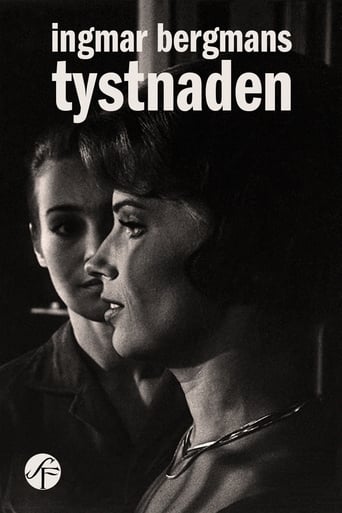
Tystnaden (1963)
Traveling through an unnamed European country on the brink of war, sickly, intellectual Ester, her sister Anna and Anna's young son, Johan, check into a near-empty hotel. A basic inability to communicate among the three seems only to worsen during their stay. Anna provokes her sister by enjoying a dalliance with a local man, while the boy, left to himself, has a series of enigmatic encounters that heighten the growing air of isolation.
- Data lansării
- 1963-09-23
- TMDB
- 7.5 / 10 (412)
- Durată
- 1 h 35 min
- Genuri
- Dramă, Romantic
- Regizor
- Ingmar Bergman
Distribuție
- Ingrid Thulin — Ester
- Gunnel Lindblom — Anna
- Birger Malmsten — Bartender
- Håkan Jahnberg — Hotel Steward
- Jörgen Lindström — Johan
- Kotti Chave — Officer in the Train Compartment
- Lissi Alandh — Woman in Variety Hall (uncredited)
- Leif Forstenberg — Man in Variety Hall (uncredited)
- Eskil Kalling — Bar Owner (uncredited)
- Karl-Arne Bergman — Paperboy (uncredited)
- Carl Andersson
- Olof Huddén
Curiozități
- Premii: 0 · Nominalizări: 1
The Silence is a 1963 Swedish drama film written and directed by Ingmar Bergman and starring Ingrid Thulin and Gunnel Lindblom. The plot focuses on two sisters, the younger a sensuous woman with a young son, the elder more intellectually oriented and seriously ill, and their tense relationship as they travel toward home through a fictional Central European country on the brink of war.
Production
After World War II, director Ingmar Bergman had visited numerous cities in other countries in Europe. He based the design of The Silence on what he had seen in these travels, in particular in Hamburg, Germany in 1946, after it had been virtually destroyed by Allied bombing attacks. He also recalled he had been inspired by a visit to a hospital, where he had witnessed an obese, elderly man being carried by four nurses.
A throat infection distracted Bergman from developing a story idea for a fairy tale film about a princess and devil, and during recovery he conceived the idea of travelers visiting a foreign city. Initially, the two main characters were supposed to be male. He told Vilgot Sjöman that he converted the characters to female because "he was afraid that the part was too close to himself".
Working titles of the film included Timoka, The City and God's Silence. According to Gado Timoka is Estonian for "pertaining to the executioner". Bergman developed the constructed language spoken in Timoka. Actually the Estonian word is timuka meaning "executioner's".
Bergman stated he "quietly" instructed Ingrid Thulin and Gunnel Lindblom on the sexual scenes, and that they did not need much convincing to participate in them. He viewed self-confidence as a necessary asset for actors and actresses to have.
The scenes in the streets and theatre were shot on a small budget. Bergman acknowledged these sets could have been more elaborate with more funding, but it may have worked to the story's advantage. Cinematographer Sven Nykvist relied less on theatrical lighting for his shots.
Citește pe Wikipedia · Text din Wikipedia, CC BY-SA 4.0. Date din Wikidata.
Recomandate
- Euforia 2018 · ★ 6.3
- Close My Eyes 1991 · ★ 5.8
- Rachel se mărită 2008 · ★ 6.3
- Caz de forță majoră 2014 · ★ 6.8
- Tentația seducției 1999 · ★ 6.9
- Visătorii 2003 · ★ 7.2
- Imigranta 2013 · ★ 6.3
- Iubește-mă, iubește-mă 2026 · ★ 6.1
- Remușcare 2007 · ★ 7.6
- Inventing the Abbotts 1997 · ★ 6.3
- A Woman of Paris: A Drama of Fate 1923 · ★ 6.7
- What We Hide 2025 · ★ 6.4