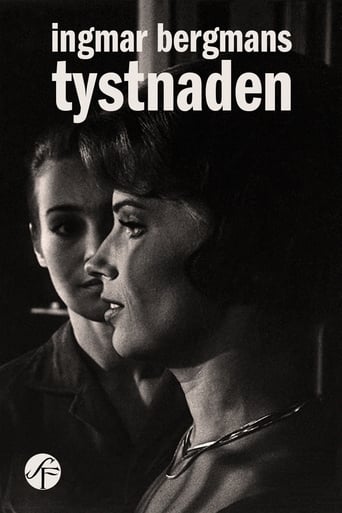
沉默 (1963)
Tystnaden
伯格曼最具震撼力的作品!惊心动魄!大胆无畏!
战争阴影还没消散的欧洲,翻译家、知识分子Ester(英格里德•图林)与妹妹Anna(冈内尔•林德布洛姆)以及Anna的儿子Johan一起坐火车回瑞典。途中,患有晚期肺病的Ester发病,三人于一个言语不通的小城下车,住进一家老宾馆。 Ester有意无意间总想偷窥Anna的生活,想对她表示好感却无从下手,而Anna一心认为Ester是她的束缚。某晚,Anna外出结识一名酒保,返回宾馆后将幻想中的性爱的过程和刺激描述给Ester听,引起对方的激烈反应,随后,她与酒保在Ester眼皮底下做爱,终引起Ester爆发,多年来深藏在两人心中的、夹杂着嫉恨与冲突的往事被重提。
演员阵容
- 英格丽德·图林 — Ester
- 古内尔·林德布洛姆 — Anna
- Birger Malmsten — Bartender
- Håkan Jahnberg — Hotel Steward
- 约根·林德斯特伦 — Johan
- Kotti Chave — Officer in the Train Compartment
- Lissi Alandh — Woman in Variety Hall (uncredited)
- Leif Forstenberg — Man in Variety Hall (uncredited)
- Eskil Kalling — Bar Owner (uncredited)
- Karl-Arne Bergman — Paperboy (uncredited)
- Carl Andersson
- Olof Huddén
趣闻
- 获奖:0 · 提名:1
The Silence is a 1963 Swedish drama film written and directed by Ingmar Bergman and starring Ingrid Thulin and Gunnel Lindblom. The plot focuses on two sisters, the younger a sensuous woman with a young son, the elder more intellectually oriented and seriously ill, and their tense relationship as they travel toward home through a fictional Central European country on the brink of war.
Production
After World War II, director Ingmar Bergman had visited numerous cities in other countries in Europe. He based the design of The Silence on what he had seen in these travels, in particular in Hamburg, Germany in 1946, after it had been virtually destroyed by Allied bombing attacks. He also recalled he had been inspired by a visit to a hospital, where he had witnessed an obese, elderly man being carried by four nurses.
A throat infection distracted Bergman from developing a story idea for a fairy tale film about a princess and devil, and during recovery he conceived the idea of travelers visiting a foreign city. Initially, the two main characters were supposed to be male. He told Vilgot Sjöman that he converted the characters to female because "he was afraid that the part was too close to himself".
Working titles of the film included Timoka, The City and God's Silence. According to Gado Timoka is Estonian for "pertaining to the executioner". Bergman developed the constructed language spoken in Timoka. Actually the Estonian word is timuka meaning "executioner's".
Bergman stated he "quietly" instructed Ingrid Thulin and Gunnel Lindblom on the sexual scenes, and that they did not need much convincing to participate in them. He viewed self-confidence as a necessary asset for actors and actresses to have.
The scenes in the streets and theatre were shot on a small budget. Bergman acknowledged these sets could have been more elaborate with more funding, but it may have worked to the story's advantage. Cinematographer Sven Nykvist relied less on theatrical lighting for his shots.
在维基百科阅读更多 · 文本来自维基百科,CC BY-SA 4.0。数据来自 Wikidata。