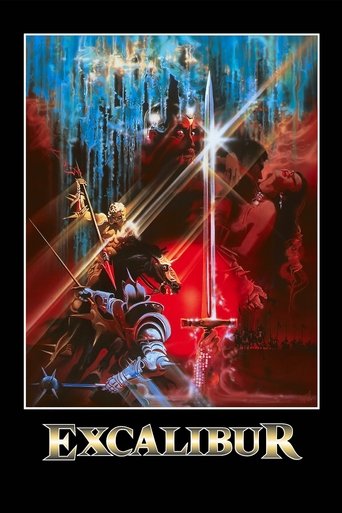
Excalibur (1981)
Forged by a god. Foretold by a wizard. Found by a king.
Arthur fulfills his fate by bringing together the Knights of the Round Table at Camelot and unifying the country. However, this flawed monarch faces greater tests ahead in pursuit of love, the Holy Grail, and his nation's survival.
- Date of release
- 1981-04-10
- TMDB
- 7.0 / 10 (1239)
- Runtime
- 2h 21m
- Genres
- Adventure, Fantasy
- Director
- John Boorman
Casting
- Nigel Terry — King Arthur
- Nicol Williamson — Merlin
- Helen Mirren — Morgana
- Nicholas Clay — Lancelot
- Paul Geoffrey — Perceval
- Cherie Lunghi — Guenevere
- Robert Addie — Mordred
- Gabriel Byrne — Uther
- Keith Buckley — Uryens
- Katrine Boorman — Igrayne
- Corin Redgrave — Cornwall
- Liam Neeson — Gawain
Interesting facts
- Budget: $11M
- Based on: Le Morte d'Arthur
- Awards: 0 · Nominations: 1
Excalibur is a 1981 medieval fantasy film directed, co-written and produced by John Boorman, that retells the legend of King Arthur and the knights of the Round Table, based loosely on the 15th-century Arthurian romance Le Morte d'Arthur by Thomas Malory. It stars Nigel Terry as Arthur, Helen Mirren as Morgana, Nicholas Clay as Lancelot, Cherie Lunghi as Guenevere, Paul Geoffrey as Perceval and Nicol Williamson as Merlin. The film is named after the legendary sword of King Arthur that features prominently in Arthurian literature. The film's soundtrack features the music of Richard Wagner and Carl Orff, along with an original score by Trevor Jones.
Production
John Boorman had planned a film adaptation of the Merlin legend as early as 1969, but when submitting the three-hour script written with Rospo Pallenberg to United Artists, they rejected it deeming it too costly and offered him J. R. R. Tolkien's The Lord of the Rings instead. Boorman was allowed to shop the script elsewhere, but no studio would commit to it.
Rospo Pallenberg and John Boorman wrote the screenplay, which is primarily an adaptation of Malory's Morte d'Arthur (1469–70) recasting the Arthurian legends as an allegory of the cycle of birth, life, decay, and restoration, by stripping the text of decorative or insignificant details. The resulting film is reminiscent of mythographic works such as Sir James Frazer's The Golden Bough and Jessie Weston's From Ritual to Romance.
In addition to Malory, the writers incorporated elements from other Arthurian stories, sometimes altering them. For example, the sword between the sleeping lovers' bodies comes from the tales of Tristan and Iseult; the knight who returns Excalibur to the water is changed from Bedivere to Perceval; and Morgause and Morgan Le Fay are merged into one character.
According to linguist Michael Everson, the "Charm of Making" that Merlin speaks to invoke the dragon is an invention, there being no attested source for the charm. Everson reconstructs the text as Old Irish. The phonetic transcription of the charm as spoken in the film is Celtic pronunciation: [aˈnaːl naθˈrax, uːrθ vaːs beˈθʌd, doxˈjeːl ˈdjenveː].
In modern English, this can be translated as:
Read on Wikipedia · Text from Wikipedia, CC BY-SA 4.0. Data from Wikidata.
Recommended
- Conan the Barbarian 1982 · ★ 6.8
- The Green Knight 2021 · ★ 6.6
- The Princess 2022 · ★ 6.8
- Mortal Kombat Legends: Scorpion's Revenge 2020 · ★ 8.1
- Highlander 1986 · ★ 6.9
- A Knight's War 2025 · ★ 6.3
- Army of Darkness 1992 · ★ 7.3
- In the Lost Lands 2025 · ★ 6.3
- The Northman 2022 · ★ 7.0
- Game of Thrones The IMAX Experience 2015 · ★ 8.6
- A Midsummer Night's Dream 1999 · ★ 6.4
- Cinderella's Curse 2024 · ★ 5.9