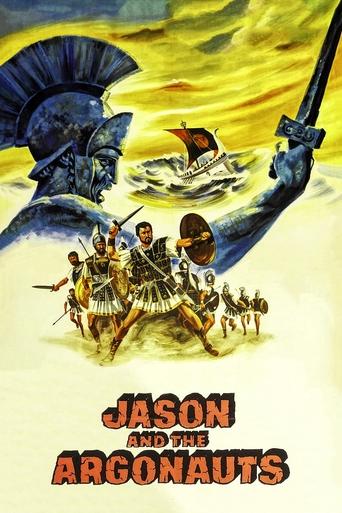
Jason and the Argonauts (1963)
The epic story that was destined to stand as a colossus of adventure!
Jason, a fearless sailor and explorer, returns to his home land of Thessaly after a long voyage to claim his rightful throne. He learns, however, that he must first find the magical Golden Fleece. To do so, he must embark on an epic quest fraught with fantastic monsters and terrible perils.
- Date of release
- 1963-06-13
- TMDB
- 7.2 / 10 (736)
- Runtime
- 1h 44m
- Genres
- Adventure, Family, Fantasy
- Director
- Don Chaffey
Casting
- Todd Armstrong — Jason
- Nancy Kovack — Medea
- Gary Raymond — Acastus
- Laurence Naismith — Argos
- Niall MacGinnis — Zeus
- Michael Gwynn — Hermes
- Douglas Wilmer — Pelias
- Jack Gwillim — Aeëtes
- Honor Blackman — Hera
- John Cairney — Hylas
- Patrick Troughton — Phineas
- Andrew Faulds — Phalerus
Interesting facts
- Budget: $3M
- Based on: Argonautica
Jason and the Argonauts is a 1963 epic fantasy adventure film loosely based on the 3rd century BC Greek epic poem The Argonautica by Apollonius Rhodius. Distributed by Columbia Pictures, it was produced by Charles H. Schneer, directed by Don Chaffey, and stars Todd Armstrong, Nancy Kovack, Gary Raymond, and Laurence Naismith.
Production
The film is one of the mythically themed fantasies scored by Bernard Herrmann. Apart from being the composer's fourth collaboration with Ray Harryhausen (The 7th Voyage of Sinbad, The 3 Worlds of Gulliver, and Mysterious Island, made in 1958, 1960, and 1961 respectively), Herrmann also collaborated with Alfred Hitchcock, worked on Citizen Kane (1941), and scored the science fiction films The Day the Earth Stood Still (1951) and Journey to the Cen…
Contrasting with Herrmann's all-string score for Psycho, the film's soundtrack was made without a string section. This leaves the brass and percussion to perform the heroic fanfares, and the woodwinds along with additional instruments (such as the harp) to dominate in the more subtle and romantic parts.
In 1995, Intrada released a re-recording of the original score. The new version was conducted by American composer/conductor Bruce Broughton, and performed by the Sinfonia of London.
The film differs in some ways from the traditional telling in Greek mythology:
Pelias does not kill his half-brother, King Aristo (Aeson), but instead had him imprisoned. Eventually, it is Medea, and not Jason, who kills Pelias; she demonstrates to Pelias' daughters that she can rejuvenate an old ram into a young one by killing, chopping and boiling it in a pot. She promises to do the same for Pelias, so his daughters kill and chop him. However, Medea breaks her word and Pelias remains dead.
Read on Wikipedia · Text from Wikipedia, CC BY-SA 4.0. Data from Wikidata.
Recommended
- Percy Jackson: Sea of Monsters 2013 · ★ 6.0
- The Dark Crystal 1982 · ★ 7.2
- Hercules and the Lost Kingdom 1994 · ★ 6.0
- Clash of the Titans 2010 · ★ 5.9
- Sinbad: Legend of the Seven Seas 2003 · ★ 7.1
- The Sea Beast 2022 · ★ 7.3
- Hercules and the Amazon Women 1994 · ★ 5.8
- Clash of the Titans 1981 · ★ 6.9
- Pirates of the Caribbean: Dead Man's Chest 2006 · ★ 7.4
- Peter Pan 2003 · ★ 7.1
- Pirates of the Caribbean: Dead Men Tell No Tales 2017 · ★ 6.7
- Pan 2015 · ★ 6.0