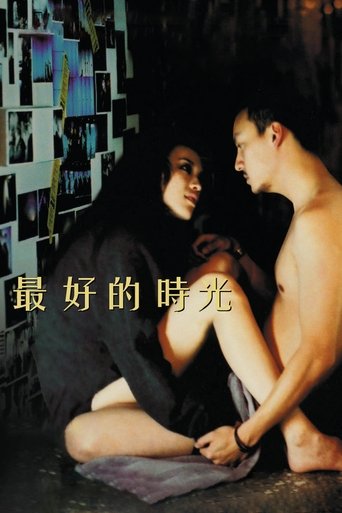
Три времени (2005)
最好的時光
Какое время самое лучшее? Как замечательно, что его нельзя вернуть. Мы помним его не потому, что оно было прекрасно, а совсем наоборот — потому что оно навсегда потеряно, и мы можем только вспоминать о нем и это делает его удивительным. Три разных времени — 1911, 1966, 2005, три истории, одни и те же актер и актриса — Мэй и Чен в фильме, воспевающем их любовь в трех разных временах.
В ролях
- Шу Ци — May / Courtesan / Jing
- Чан Чэнь — Chen / Mr. Chang / Zhen
- 廖淑珍 — Hostess / Madam / Jing's Mother
- Mei Di — May's Mother / Madam / Aunt
- 陈士争 — Haruko / Ah Mei / Blue
- Lee Pei-Hsuan — Yue / Mickey
- 梅芳 — Old Woman
- 柯宇綸
- 王誌成
Интересные факты
Three Times is a 2005 Taiwanese film directed by Hou Hsiao-hsien. It consists of three separate stories of romance, set in different eras, using the same lead actors, Shu Qi and Chang Chen. In "A Time for Love," set in 1966, a soldier (Chang) meets an alluring pool-hall hostess (Shu). "A Time for Freedom," set in 1911, focuses on a courtesan's relationship with a freedom fighter during the Japanese occupation of Taiwan. In "A Time for Youth," set in 2005, a singer forsakes her female lover for a photographer with whom she's having an affair.
Production
Three Times was originally meant to be an omnibus collection of short films, with Hou directing only one of the segments. But the producers were unable to obtain the financing to hire three directors, so Hou took over the whole production. Hou cast Shu Qi for the female lead roles, marking his second collaboration with her, after 2001's Millennium Mambo.
The film's Chinese title is best translated as "Our Best Moments", and Hou has said the stories are somewhat inspired by his memories. He has said, "It seems to me that by contrasting love stories from three different times, we can feel how people's behavior is circumscribed by the times and places they live in. [...] I'm pushing sixty, and these things have been hanging around for so long it seems like they're part of me.
Discussing Three Times in an interview for Artificial Eye’s UK DVD edition, Hou said:
I feel that every era has its own distinctive sense. These eras will never come again. Time keeps moving forward. One’s environment and one’s thoughts keep changing as well. They’ll never come again. It’s not that they’re good times, it’s because we’re recalling them that we call them good times.
It has been reported that there was not enough time for the actors to learn their dialogue for the second segment, so Hou chose to use inter-titles instead.
Читать в Википедии · Текст из Википедии, CC BY-SA 4.0. Данные Викиданных.
Рекомендуем
- Интимный словарь 2003 · ★ 6.6
- Любовник леди Чаттерлей 2015 · ★ 6.3
- Я влюбился в монашку 2013 · ★ 5.9
- Смерть в Голливуде 2002 · ★ 5.8
- Пурпурные сердца 2022 · ★ 8.0
- Влюбленные женщины 1969 · ★ 6.6
- Her Story 2024 · ★ 7.6
- Love Everlasting 2016 · ★ 7.4
- Наперегонки с луной 1984 · ★ 6.3
- Легко не сдаваться 2009 · ★ 6.3
- The Golden Era 2014 · ★ 6.7
- Круг друзей 1995 · ★ 6.3