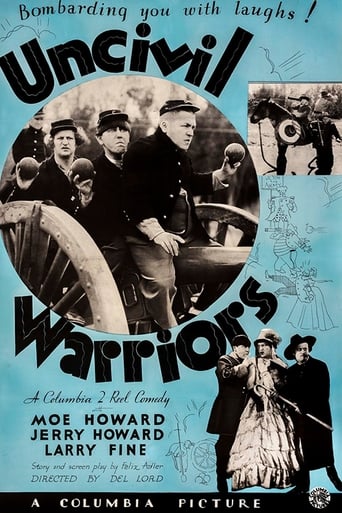
Uncivil Warriors (1935)
Set in the civil war, the stooges are spies for the north. They impersonate southern officers and infiltrate the enemy ranks to get valuable information. On the run when they are discovered, they hide in a cannon and are blown back to their northern headquarters.
Cast
- Curly Howard — Curly
- Larry Fine — Larry
- Moe Howard — Moe
- Lou Archer — Charlie (uncredited)
- Heinie Conklin — Confederate Sentry (uncredited)
- Phyllis Crane — Miss Judith Buttz (uncredited)
- Charles Cross — Soldier (uncredited)
- Lew Davis — Union Orderly (uncredited)
- Hubert Diltz — Soldier (uncredited)
- Charles Dorety — Union Burglar (uncredited)
- Celeste Edwards — Clementine Buttz (uncredited)
- Billy Engle — Captain (uncredited)
Curiosità
Uncivil Warriors is a 1935 short subject directed by Del Lord starring American slapstick comedy team The Three Stooges. It is the eighth entry in the series released by Columbia Pictures starring the comedians, who released 190 shorts for the studio between 1934 and 1959.
Production notes
Uncivil Warriors was filmed on March 13–18, 1935. It is the first short in which the Stooges mention "Good Time Charlie". When the Stooges meet a guard, they often reference Charlie. The guard asks who Charlie is, and a Stooge replies that "everybody knows Charlie. He walks like this." The Stooges then demonstrate a silly walk until they get clear of the guard, at which point they take off running. This is a recurring joke in the Stooge shorts.
The potholder gag would later appear in the Shemp-era short Three Hams on Rye during a live theatrical production. A similar sequence also appears in the 1947 short All Gummed Up, also featuring Shemp. The scene is nearly identical, with bubblegum being used in the place of a potholder, the stooges coughing up bubbles rather than feathers as a result.
When Moe brings the black baby into the Colonel's office he attempts to explain how the baby got his dark complexion ("We had him down the beach all summer...he got quite sunburned!"); this is sometimes deleted for U.S. television broadcasts.
The introductory music over the titles is a medley of "Battle Hymn of the Republic" (most popular marching song of the Union Army) and "Dixie" (which had the same status in the Confederate Army).
Leggi su Wikipedia · Testo da Wikipedia, CC BY-SA 4.0. Dati da Wikidata.
Consigliati
- Papà, ma che cosa hai fatto in guerra? 1966 · ★ 5.9
- Gianni e Pinotto reclute 1941 · ★ 6.8
- Charlot soldato 1918 · ★ 6.8
- Oh, che bella guerra! 1969 · ★ 6.6
- La grande s...parata 1958 · ★ 6.4
- Il dottor Stranamore, ovvero: come ho imparato a non preoccuparmi e ad amare la bomba 1964 · ★ 8.1
- Johnny English colpisce ancora 2018 · ★ 6.3
- La guerra lampo dei fratelli Marx 1933 · ★ 7.3
- Arrivano i Russi, arrivano i Russi 1966 · ★ 6.5
- La prova del fuoco 1951 · ★ 6.4
- Wrong Cops 2013 · ★ 6.1
- A proposito di omicidi... 1978 · ★ 6.4