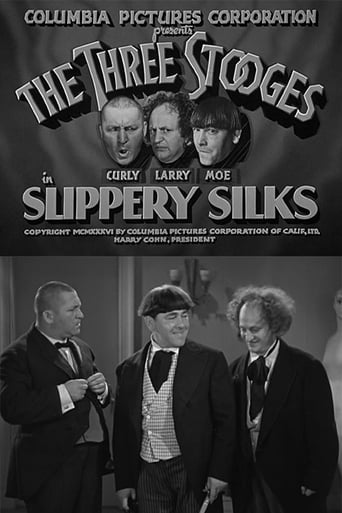
Slippery Silks (1936)
The Stooges are carpenters who inherit a fancy dress boutique. They put on a fashion show with dresses they've designed based on furniture. During the show the owner of a antique box the stooges wrecked shows up and a wild cream puff fight ensues.
- Date de sortie
- 1936-12-27
- TMDB
- 7.1 / 10 (15)
- Durée
- 18 min
- Genres
- Comédie
- Réalisateur
- Jack White
Distribution
- Curly Howard — Curly
- Moe Howard — Moe
- Larry Fine — Larry
- Vernon Dent — Morgan Morgan (uncredited)
- Loretta Andrews — The Hunt Model (uncredited)
- Gail Arnold — June Bride Model (uncredited)
- Beatrice Blinn — Sales Clerk (uncredited)
- Symona Boniface — Mrs. Morgan Morgan (uncredited)
- Beatrice Curtis — Sales Clerk (uncredited)
- Lew Davis — Lawyer (uncredited)
- Helen Dickson — Fashion Show Guest (uncredited)
- Mary Lou Dix — 'Lingerie' Model (uncredited)
Anecdotes
Slippery Silks is a 1936 short subject directed by Preston Black starring American slapstick comedy team The Three Stooges. It is the 19th entry in the series released by Columbia Pictures starring the comedians, who released 190 shorts for the studio between 1934 and 1959.
Production notes
Slippery Silks was filmed from June 10 to June 15, 1936. The film represents the Stooges' iirst genuine pie and pastry altercation. Although it involves predominantly cream puffs, a pie becomes inadvertently launched amidst the chaos when Curly obstructs Moe's trajectory while attempting to retrieve a "lucky penny", resulting in him being struck in the face with a pie.
Moe Howard stated in his autobiography that over 150 pies were thrown. In Moe's June 8, 1973, appearance on The Mike Douglas Show, he revealed to Douglas that, in making the Stooge pie-fight scenes, he was responsible for most of the pie-throwing, remarking: "the studio auditors claimed I had saved them tens of thousands of dollars with my accuracy in the pie throw." The pie fight scenes were used in the Muppet Babies episode, "Good, Clean, Fun".
"Preston Black" was a pseudonym used for a time by Jack White (brother of producer Jules White), who had been in a nasty divorce and was trying to shield income from his ex-wife.
The ending theme of "Listen to the Mockingbird" features different instrumentation.
Lire sur Wikipédia · Texte de Wikipédia, CC BY-SA 4.0. Données de Wikidata.
Recommandés
- Un chef de rayon explosif 1963 · ★ 6.8
- Charlot joue Carmen 1915 · ★ 5.8
- Charlot marin 1915 · ★ 6.0
- Laurel Et Hardy - Les Deux Légionnaires 1931 · ★ 6.8
- Les Rois de la gaffe 1935 · ★ 6.8
- Laurel Et Hardy - Le Bateau hanté 1934 · ★ 7.2
- Charlot et le Comte 1916 · ★ 6.2
- Laurel et Hardy - Les deux flemmards 1933 · ★ 6.5
- Laurel et Hardy - Qui dit mieux ! 1935 · ★ 7.4
- Laurel et Hardy - Justes noces 1931 · ★ 7.1
- Laurel et Hardy - Marchands de poisson 1932 · ★ 7.0
- Laurel Et Hardy - Drôles de bottes 1931 · ★ 6.8