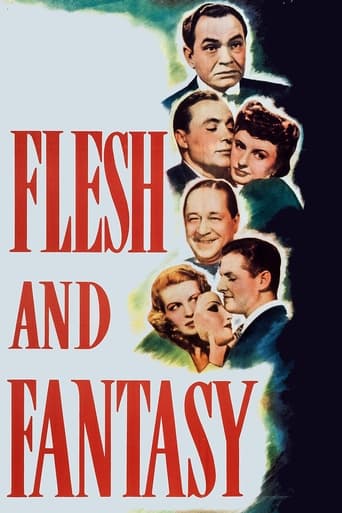
Flesh and Fantasy (1943)
The motion picture above all!
Anthology film of three tales of the supernatural. The first story is set at the Mardi Gras in New Orleans. The second involves a psychic who predicts murder. The third is about a man who literally meets the girl of his dreams.
- Date of release
- 1943-10-29
- TMDB
- 7.1 / 10 (22)
- Runtime
- 1h 33m
- Genres
- Mystery, Romance, Thriller, Horror
- Director
- Julien Duvivier
Casting
- Charles Boyer — Paul Gaspar (segment 3)
- Edward G. Robinson — Marshall Tyler (segment 2)
- Barbara Stanwyck — Joan Stanley (segment 3)
- Betty Field — Henrietta (segment 1)
- Robert Cummings — Michael (segment 1)
- Thomas Mitchell — Septimus Podgers (segment 2)
- Charles Winninger — King Lamarr (segment 3)
- Anna Lee — Rowena (segment 2)
- May Whitty — Pamela Hardwick (segment 2)
- C. Aubrey Smith — Dean of Norwalk (segment 2)
- Robert Benchley — Doakes
- Edgar Barrier — Stranger in Mask Shop (segment 1)
Interesting facts
Flesh and Fantasy is a 1943 American horror fantasy film directed by Julien Duvivier and starring Edward G. Robinson, Charles Boyer, Robert Cummings and Barbara Stanwyck. The film follows the success of Duvivier's previous anthology film Tales of Manhattan (1942). Flesh and Fantasy tells three stories, unrelated but with a supernatural theme, written by Ellis St. Joseph, Oscar Wilde and László Vadnay. Interstitial scenes to connect and present the three segments feature humorist Robert Benchley.
Production
The film's working title was For All We Know. Robert Cummings and Betty Field were cast in March 1943.
A 30-minute segment concerning an escaped killer (Alan Curtis) who finds refuge with a farmer (Frank Craven) and his blind daughter (Gloria Jean) was produced but not included in the final film. Warner Bros. contract star John Garfield had been loaned to Universal for the lead role, but he refused the part because he would only consider assignments that had relevance to the current war effort. Garfield was suspended by Warner Bros.
The deleted segment ended with a spectacular storm scene in which the enraged killer races after the girl. Preview audience reacted positively to the scene, but Universal removed and shelved it. The end of the deleted scene survives in the final print, in which the killer's body is shown reaching the shore. To replace the excised footage, the studio connected the remaining three segments with scenes featuring humorist Robert Benchley.
Universal hired screenwriter Roy Chanslor to devise additional material and Reginald LeBorg to direct several new scenes so that the removed segment could be released as a separate feature film. The studio demanded new framing sequences to depict the refugee as innocent of the crimes for which he has been imprisoned and to provide a happy ending. The completed film was released in 1944 as Destiny.
Read on Wikipedia · Text from Wikipedia, CC BY-SA 4.0. Data from Wikidata.
Recommended
- Nocebo 2022 · ★ 6.0
- Southbound 2015 · ★ 5.9
- Dead of Night 1977 · ★ 6.1
- Frank and Penelope 2022 · ★ 7.3
- Shuffle 2012 · ★ 6.4
- The Hideout 2007 · ★ 6.2
- Night Watch 1973 · ★ 6.3
- Maniac 1963 · ★ 6.2
- God Is a Bullet 2023 · ★ 6.3
- The Signal 2007 · ★ 5.9
- Black Rainbow 1989 · ★ 5.9
- The Lady Vanishes 2013 · ★ 6.3