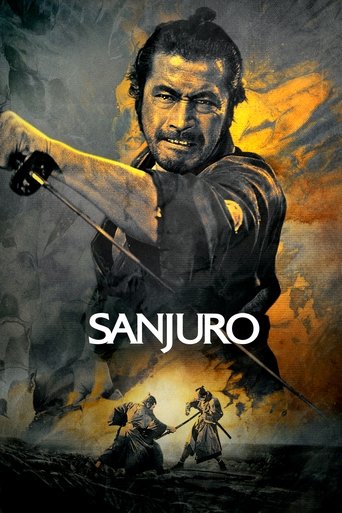
Sanjuro (1962)
椿三十郎
You cut well, but the best sword stays in its sheath!
In this companion piece and sequel to "Yojimbo," jaded samurai Sanjuro helps an idealistic group of young warriors weed out their clan's evil influences, and in the process turns their image of a proper samurai on its ear.
- Date of release
- 1962-01-01
- TMDB
- 7.9 / 10 (761)
- Runtime
- 1h 36m
- Genres
- Drama, Action, Comedy
- Director
- Akira Kurosawa
- Collection
- Sanjuro Collection
Casting
- Toshirō Mifune — Sanjûrô Tsubaki / The ronin
- Tatsuya Nakadai — Hanbei Muroto
- Keiju Kobayashi — The Spy
- Yūzō Kayama — Iori Izaka
- Reiko Dan — Chidori, Mutsuta's daughter
- Takashi Shimura — Kurofuji
- Kamatari Fujiwara — Takebayashi
- Takako Irie — Mutsuta's wife
- Masao Shimizu — Kikui
- Yūnosuke Itō — Mutsuta, the Chamberlain
- Akira Kubo — Samurai
- Hiroshi Tachikawa — Samurai
Interesting facts
- Filmed in: Japan
Sanjuro is a 1962 Japanese jidaigeki film directed, co-written and edited by Akira Kurosawa, starring Toshiro Mifune. It is a sequel to Kurosawa's 1961 Yojimbo.
Production
The story is primarily based on Shūgorō Yamamoto's short story Hibi Heian (日日平安; lit. "Peaceful Days"). Originally Sanjuro was to be a straight adaptation of the story. After the success of Yojimbo the studio decided to resurrect its popular antihero, and Kurosawa reimagined the script accordingly.
He is, as before, a masterless samurai who preserves his anonymity by the same means. When asked his name in Yojimbo he looks outside and names himself mulberry (Kuwabatake); in Sanjuro he chooses a camellia (Tsubaki). In both cases he gives Sanjūrō (thirty-year-old) as his given name, although in both films he admits to being closer to forty.
There is also a greater element of social comedy, with the seasoned fighter constantly hampered by the failure of the young men whom he chooses to help to grasp the reality of the situation. But while he is their superior in tactics, the lady he has just rescued confounds him by insisting that he restrain himself, since killing people is a bad habit.
The final duel between Sanjuro and Hanbei ends with Sanjuro striking Hanbei with his sword, causing Hanbei's body to issue a dramatic spray of blood in a show of extreme graphic violence, unusual for the time the film was made. Despite contradicting claims about this being the result of a mechanical failure, Kurosawa claimed in a 1980 interview that the effect was intentional, done as an "experiment".
Read on Wikipedia · Text from Wikipedia, CC BY-SA 4.0. Data from Wikidata.
Recommended
- Kagemusha 1980 · ★ 7.8
- Hana 2006 · ★ 6.6
- Gintama 2: Rules Are Made to Be Broken 2018 · ★ 7.1
- 47 Ronin 2013 · ★ 6.2
- Lupin the 3rd 2014 · ★ 5.9
- City Hunter: Shinjuku Private Eyes 2019 · ★ 6.4
- Gintama: The Very Final 2021 · ★ 8.2
- Lone Wolf and Cub: Baby Cart at the River Styx 1972 · ★ 7.4
- Gintama: The Movie 2010 · ★ 7.5
- One Piece: The Desert Princess and the Pirates: Adventure in Alabasta 2007 · ★ 6.9
- New Tale of Zatoichi 1963 · ★ 7.0
- One Piece: Baron Omatsuri and the Secret Island 2005 · ★ 7.2