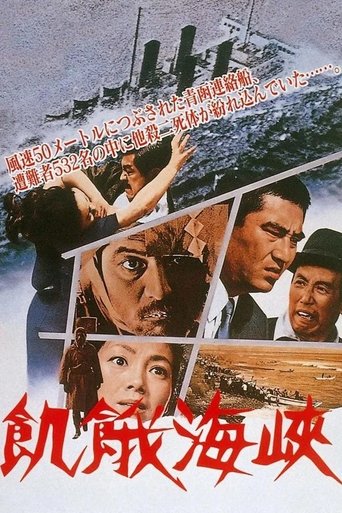
飢餓海峡 (1965)
Three robbers escape with loot from a heist before one of them kills the others. Their corpses wash up near the aftermath of a maritime calamity, provoking a policeman's interest.
- Erscheinungsdatum
- 1965-01-15
- TMDB
- 7.3 / 10 (50)
- Laufzeit
- 3 Std. 3 Min.
- Genres
- Krimi, Drama, Mystery
- Regie
- 内田吐夢
Besetzung
- Rentarō Mikuni — Takichi Inukai
- 左幸子 — Yae Sugito
- Mitsui Koji — Motojima
- 加藤嘉 — Yae's Father
- 沢村貞子 — Motojima's Wife
- Susumu Fujita — Police Chief
- 風見章子 — Toshiko
- 亀石征一郎 — Priest
- 沢彰謙
- 菅沼正 — Detective Sato
- 関山耕司 — Detective Horiguchi
- 八名信夫 — Machida
Wissenswertes
A Fugitive from the Past is a 1965 Japanese crime drama film directed by Tomu Uchida and starring Rentarō Mikuni, Sachiko Hidari, Ken Takakura and Junzaburō Ban. It was written by Naoyuki Suzuki based on the 1963 novel Kiga Kaikyō by Tsutomu Minakami.
Production
Shigeru Okata, chairman of Toei's Tokyo studio, suggested Tomu Uchida, who had expressed a desire to explore more contemporary subject matter, adapt Tsutomu Minakami's 1963 detective novel Kiga Kaikyō. However, Okata was then transferred to Toei's Kyoto studio, thus, new Toei Tokyo chairman Kimiharu Tsujino took over the project. Naoyuki Suzuki was chosen to write the script and Uchida's son, Yusaku, oversaw production, which began in May 1964.
Rentarō Mikuni was cast as Kyoichiro Tarumi, and Sachiko Hidari plays Yae Sugito, a role Toei initially considered Yoshiko Sakuma for. Isamu Kosugi was initially set to play Detective Yumisaka, but dropped out due to scheduling conflicts. Comedian Junzaburō Ban, not known for dramatic roles, got the part largely due to his Tōhoku accent.
Shooting was planned to last from summer to autumn. But the night scene depicting the capsizing of the ferry, which utilized over 500 extras and a large number of cars, was delayed for days because, as Inuhiko Yomota wrote, "a typhoon failed to conveniently strike". The crew became frustrated and Uchida grew irritated and depressed. Filming ran two weeks behind schedule, concluding at the end of October 1964.
To achieve a grainy effect on the images, A Fugitive from the Past was shot on 16 mm film, blown up to 35 mm and the film material manipulated. According to filmmaker Ryota Nakanishi, Uchida, aided by cinematographer Hanjiro Nakazawa, used three different techniques.
Auf Wikipedia weiterlesen · Text aus Wikipedia, CC BY-SA 4.0. Daten aus Wikidata.
Empfohlen
- Tödliche Parties 1986 · ★ 6.0
- Jeff Jackson - Der Fluch der Smaragdbrosche 2020 · ★ 7.4
- Gemini Lounge - Der Mafia-Kodex 2023 · ★ 6.2
- Mord mit verteilten Rollen 1986 · ★ 6.4
- The Locksmith - Der Spezialist 2023 · ★ 5.9
- Mit Liebe zum Mord 14: Tödliches Klassentreffen 2020 · ★ 7.3
- Suburbicon 2017 · ★ 5.9
- Shimmer Lake 2017 · ★ 5.9
- Alle Teufel sind hier 2025 · ★ 6.2
- Mord im Pfarrhaus 1986 · ★ 6.7
- The International 2009 · ★ 6.3
- Kurzer Prozess - Righteous Kill 2008 · ★ 5.9