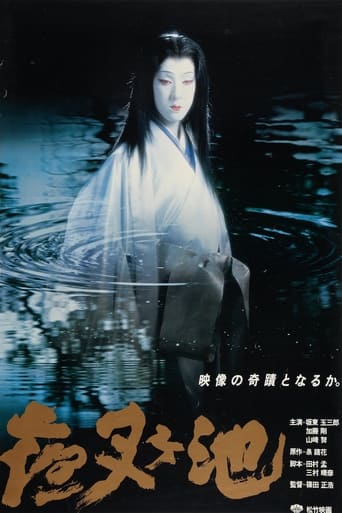
Озеро демона (1979)
夜叉ヶ池
Существует поверье, что в пруду Ясягаикэ живет дракон. Много лет назад жители деревни заключили с ним сделку. Каждый день колокол храма должен звонить три раза. До тех пор, пока этот порядок будет соблюдаться, дракон не станет выходить из воды, и деревня не будет затоплена. Акира приехал из Токио несколько лет назад, чтобы записывать местные легенды и рассказы. Он взял в жены местную красавицу, сиротку Юки, а сам сделался звонарем в храме. Легенда о драконе настолько поразила его, что когда предыдущий звонарь умер, Акира решил взять на себя соблюдение соглашения с драконом. Но с наступлением засухи многие в деревне хотели бы, чтобы пруд разлился. Хочет этого и божество водоема – принцесса Сираюки, уже давно мечтающая воссоединиться со своим возлюбленным.
В ролях
- 五代目 坂東玉三郎 — Yuri / Princess Shirayuki
- 加藤剛 — Akira Hagiwara
- 山崎努 — Gaukuen Yamazaki
- 南原宏治 — Priest Shikami
- 丹阿弥谷津子 — Nurse
- 井川比佐志 — The Carp
- 三木のり平 — Catfish Messenger
- 唐十郎 — Denkichi
- 金田龍之介 — Diet Member
- Фудзио Токита — The Crab
- Дзюн Хамамура — The Shadow / Yatabei, the Bellkeeper
- Megumi Ishii — The Camellia
Интересные факты
- Основан на: Demon Pond
Demon Pond is a 1979 Japanese romantic fantasy film directed by Masahiro Shinoda. It is an adaptation of the 1913 play of the same name by Izumi Kyōka, with an adapted screenplay written by Haruhiko Mimura and Tsutomu Tamura. The film stars Tsutomu Yamazaki, Go Kato, and Kabuki actor Tamasaburo Bando.
Production
In 1978, a popular stage production of the Demon Pond play was shown in Japan. This stirred interest in creating a film version of the play. Tamasaburo Bando, at the time a world-famous Kabuki onnagata actor, was brought on to star in the film playing the dual role of Yuri and Yuki. As this was Bando's film debut, he was not used to the idiosyncrasies of film, particularly, the use of closeups.
The film is based on a kabuki stage production, and follows some elements of the format such as a five act format. However, the film has the married couple embrace in a kiss which is atypical in kabuki but common in film.
Masao Kosugi was the cinematographer for the film, and had previously worked with Shinoda on The Assassin. The film's score, composed by Isao Tomita, heavily utilizes Moog synthesizers, mixing classical and electronic music genres.
Nobuo Yajima was hired as the special effects director for the film. He made extensive use of composite shots in the film, and utilized an optical printer to combine different shots. Blue screens and miniature sets were also used, particularly during the scene where the village floods.
Читать в Википедии · Текст из Википедии, CC BY-SA 4.0. Данные Викиданных.
Рекомендуем
- Сказочный принц 2001 · ★ 6.9
- Сакура — собирательница карт (фильм первый) 1999 · ★ 7.7
- Момо 2025 · ★ 7.1
- Малефисента 2014 · ★ 7.1
- София Прекрасная: История принцессы 2012 · ★ 7.4
- Привидение 2018 · ★ 7.2
- Beauty and the Beast: A 30th Celebration 2022 · ★ 6.8
- Джек - покоритель великанов 2013 · ★ 5.9
- Мифика: Задание для героев 2014 · ★ 5.8
- Ариэтти из страны лилипутов 2010 · ★ 7.7
- Тайна Мунакра 2009 · ★ 6.6
- Тайна зубных фей 2025 · ★ 8.5