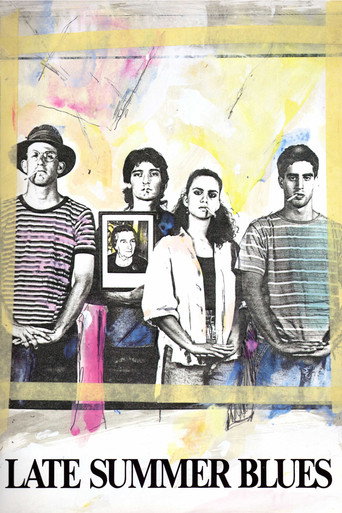
Late Summer Blues (1987)
בלוז לחופש הגדול
The time: 1970, the end of the War of Attrition. Mossi, Arah'le, Margo, Zvillich, Kobi, Naomi and Shosh – the protagonists of Late Summer Blues – live out their last summer vacation at the beach, in the streets, and on the rooftops of Tel Aviv, throwing caution to the wind as if there were no tomorrow, as if they were going to die tomorrow.
- Date of release
- 1987-06-26
- TMDB
- 7.8 / 10 (6)
- Runtime
- 1h 41m
- Genres
- Romance, Drama, Music
- Director
- Renen Schorr
Casting
- Yoav Tsafir — Mossi
- Dor Zweigenbom — Arah'le
- Shahar Segal — Margo
- Omri Dolev — Zvillich
- Noa Goldberg — Naomi
- Vered Cohen — Shosh
- Sharon Bar-Ziv — Kobi
- Edna Fliedel — School Principal
- Miki Kam — Secretary
- Moshe Havazelet — Mossi's Father
- Maxi Nesher — Strikovsky
- Ariella Miniely — Hava Carmelli
Interesting facts
Late Summer Blues is an Israeli feature film directed by Renen Schorr, written by Doron Nesher and produced by Ilan de Vries. Initially released in 1987, the film was a box office hit and went on to become an Israeli classic. In 2016, after undergoing extensive digital image and sound restoration, it was rereleased to cinemas, becoming the first Israeli film to do so.
Development and production
Renen Schorr first wrote the film's outline in 1976, while still a student at Tel Aviv University's film department. It was based on his experiences with his own class, who wrote the famous "Senior's Letter" in Tel Aviv and Jerusalem in 1970, during the War of Attrition.
Two years later, Doron Nesher, then a young Israeli actor who had already taken part in George Roy Hill's The Little Drummer Girl, joined Schorr in writing the screenplay. Nesher and Schorr wrote seven drafts between 1978 and 1985, all rejected by the Israel Film Fund.
In 1985, the Israel Film Fund, supported by the Ministry of Education and Culture, finally approved the film's production. That winter, the film began shooting with a low budget of $150,000, and was the first full-length film for most of the cast and crew.
While casting, Schorr searched for actors with a "typical" Israeli look, and wasn't afraid to cast unknown actors and "non-actors", hoping to create a "fuller" Israeli experience. A large part of the film's concept was connecting with Israeli and Tel Avivian culture, out of pride of it, and despite commercial considerations.
During rehearsals, to connect the young cast to the 1960s feeling of "changing the world", Schorr and Nesher shared and studied a large collection of records (Bob Dylan, Leonard Cohen, Jimi Hendrix, The Doors, Janis Joplin), books (by Herbert Marcuse, Viktor Frankl and more) and films (Rebel Without a Cause, Hair, The Deer Hunter Alice's Restaurant, Breaking Away and more) with them.
Read on Wikipedia · Text from Wikipedia, CC BY-SA 4.0. Data from Wikidata.
Recommended
- Ruth & Boaz 2025 · ★ 7.4
- Hounddog 2008 · ★ 6.5
- Coda 2020 · ★ 6.1
- Clika 2026 · ★ 8.3
- Young at Heart 1954 · ★ 6.1
- Battle of the Year 2013 · ★ 6.8
- Honeydripper 2007 · ★ 5.9
- Listen to Your Heart 2010 · ★ 7.1
- Pure Country 2: The Gift 2010 · ★ 6.7
- Smithereens 1982 · ★ 6.4
- I Still Believe 2020 · ★ 7.6
- Teen Spirit 2019 · ★ 6.0