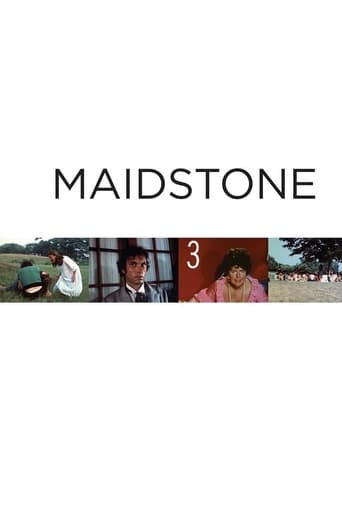
Maidstone (1971)
A Mystery by Norman Mailer
Over a booze-fueled, increasingly hectic five-day shoot in East Hampton, Norman Mailer and his cast and crew spontaneously unloaded onto film the lurid and loony chronicle of U.S. presidential candidate and filmmaker Norman T. Kingsley debating and attacking his hangers-on and enemies. This gonzo narrative, “an inkblot test of Mailer’s own subconscious” (Time), becomes something like a documentary on its own making when costar Rip Torn breaks the fourth wall in one of cinema’s most alarming on-screen outbursts.
- Date of release
- 1971-03-09
- TMDB
- 4.2 / 10 (12)
- Runtime
- 1h 46m
- Genres
- Drama
- Director
- Norman Mailer
Casting
- Norman Mailer — Norman T. Kingsley
- Rip Torn — Raoul Rey O'Houlihan
- Paul Austin
- Joy Bang — Joy Broom
- Ann Barry
- Beverly Bentley — Chula Mae Kingsley
- Eddie Bonette
- Steve Borton
- Robert Byrne
- Jean Campbell — Jeanne Cardigan
- Paul Carroll
- Lang Clay
Interesting facts
Maidstone is a 1970 American independent drama film written, produced and directed by Norman Mailer. It stars Mailer, Rip Torn and Ultra Violet. The film focuses on a famous film director Norman Kingsley, who runs for president while a group of friends, relatives, employees and lobbyists gather to discuss possible assassination plots against him. The title refers to a private country club in East Hampton, New York.
Production
Produced during the media height of The Armies of the Night and leading to the writing of Miami and the Siege of Chicago, Maidstone was created during a politically and culturally changing era of American history. Although released in 1970-1971, Maidstone was produced just one month after the assassination of Robert Kennedy and three months after Martin Luther King, Jr.'s assassination.
Maidstone is the final of three underground films written and directed by Norman Mailer in the late 1960s and was his largest production in terms of capital expenses and physical and emotional expenditures. The film began production in 1968 and was not completed until 1970.
The original footage was 45 hours long, but after the editing process the producers came up with a 110-minute film. It took them three weeks to watch the 45 hours of film, then about six months to cut it into 7.5 hours. According to Mailer, the crew worked a long time before they could get down to the 3.5-hour version, which no longer exists. "At that point, down from 7 ½ hours, it's a totally different film.
In 1971, Mailer published the screenplay (from the transcript of the finished movie), along with accounts of the filming, film stills, and his essay “A Course in Filmmaking”.
Mailer pointed to his lack of experience as an inadvertent film producer as the main factor for inflated spending on his films Wild 90, Beyond the Law and Maidstone. The film cost $200,000 to produce, causing Mailer to sell part of his interest in The Village Voice. The film would eventually bankrupt Mailer before completion.
Read on Wikipedia · Text from Wikipedia, CC BY-SA 4.0. Data from Wikidata.
Recommended
- What Maisie Knew 2013 · ★ 7.1
- Come Sunday 2018 · ★ 5.8
- The Sound of Silence 2019 · ★ 5.9
- El Chicano 2019 · ★ 6.6
- The Girl in the Book 2015 · ★ 5.8
- National Theatre Live: Hamlet 2015 · ★ 7.5
- Gracie 2007 · ★ 6.2
- Hands of Stone 2016 · ★ 6.6
- 1 2020 · ★ 6.7
- Girl in the Box 2016 · ★ 6.7
- Fast Girls 2012 · ★ 6.0
- Rebound: The Legend of Earl 'The Goat' Manigault 1996 · ★ 7.1