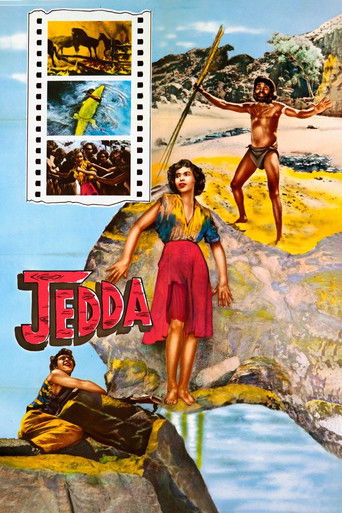
Jedda (1955)
It was DEATH for him to look on this Girl!
An aboriginal girl is brought up by a white family that adopts her. As a young woman, she is mysteriously drawn to go "Walkabout" as people of her tribe have for hundreds of years.
- Date of release
- 1955-05-05
- TMDB
- 6.0 / 10 (11)
- Runtime
- 1h 41m
- Genres
- Adventure, Drama
- Director
- Charles Chauvel
Casting
- Rosalie Kunoth-Monks — Jedda
- Robert Tudawali — Marbuck
- Betty Suttor — Sarah McMann
- Paul Reynall — Joe
- George Simpson-Lyttle — Douglas McMann
- Margaret Dingle — Little Jedda
- Willie Farrar — Little Joe
- Tas Fitzer — Peter Wallis - Police Officer
- Wason Byers — Felix Romeo - Boss Drover
- Dixie Lee — Aboriginal (uncredited)
- Nosepeg
Interesting facts
- Filmed in: Australia
Jedda, released in the UK as Jedda the Uncivilised, is a 1955 Australian film written, produced and directed by Charles Chauvel. His last film, it is notable for being the first to star two Aboriginal actors, Robert Tudawali and Rosalie Kunoth-Monks in the leading roles. It was also the first Australian feature film to be shot in colour.
Production
Filming started in May 1952, when the unit left Sydney for Darwin. By this stage the lead role of Jedda had still yet to be cast, but filming acting sequences did not begin until July. Robert Tudawali was an Aboriginal man from Melville Island, the largest island in the Tiwi Islands group.
The shoot took five months to complete, plus post-production work done in Sydney. Most of the scenes were shot on the Coolibah Station in the Northern Territory, as well as at Standley Chasm, Ormiston Gorge and Mary River in the north.
The production process was laborious, as the colour technique used, Gevacolor, could only be processed in England. The film stock was fragile and heat-sensitive, which was a problem in the tropical climate of the Northern Territory. During production, the film was stored in cool caves to protect it from deteriorating. By mid 1952 the film had incurred expenses of £24,673.
The last roll of negative was destroyed in a plane crash on its way for developing in England. Chauvel re-shot these lost scenes at Kanangra Walls in the Blue Mountains and Jenolan Caves west of Sydney. Cave scenes were filmed in the River Cave, Diamond Cave, Imperial Cave, and Mud Tunnels at Jenolan. Editing and sound recording were completed in London.
The music was written by Isador Goodman. Elsa Chauvel, the director's wife, replaced large parts of Goodman's score with old-fashioned commercial "mood" music.
Read on Wikipedia · Text from Wikipedia, CC BY-SA 4.0. Data from Wikidata.
Recommended
- Lion 2016 · ★ 8.0
- Rabbit-Proof Fence 2002 · ★ 7.0
- Walkabout 1971 · ★ 7.3
- The Emerald Forest 1985 · ★ 6.6
- Last Ride 2009 · ★ 6.4
- Black Gold 2011 · ★ 6.5
- Tarzan 1999 · ★ 7.4
- The Nightingale 2018 · ★ 7.0
- High Ground 2021 · ★ 6.4
- The Blind Side 2009 · ★ 7.7
- Into the Wild 2007 · ★ 7.8
- Ainbo: Spirit of the Amazon 2021 · ★ 7.0