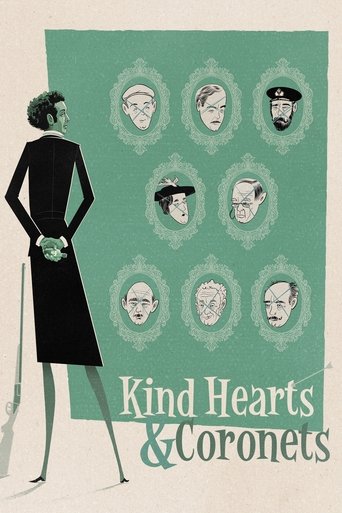
Kind Hearts and Coronets (1949)
He chopped down the family tree...
When his mother eloped with an Italian opera singer, Louis Mazzini was cut off from her aristocratic family. After the family refuses to let her be buried in the family mausoleum, Louis avenges his mother's death by attempting to murder every family member who stands between himself and the family fortune. But when he finds himself torn between his longtime love and the widow of one of his victims, his plans go awry.
- Date of release
- 1949-06-23
- TMDB
- 7.6 / 10 (640)
- Runtime
- 1h 44m
- Genres
- Comedy, Crime
- Director
- Robert Hamer
Casting
- Dennis Price — Louis Mazzini / His Father
- Alec Guinness — The D'Ascoyne Family: The Duke / The Banker / The Parson / The General / The Admiral / Young Ascoyne / Young Henry / Lady Agatha
- Joan Greenwood — Sibella
- Valerie Hobson — Edith D'Ascoyne
- Audrey Fildes — Mama
- Miles Malleson — The Hangman
- Clive Morton — The Prison Governor
- John Penrose — Lionel Holland
- Cecil Ramage — Crown Counsel
- Hugh Griffith — Lord High Steward
- John Salew — Mr. Perkins
- Eric Messiter — Inspector Burgoyne
Interesting facts
- Based on: Israel Rank: The Autobiography of a Criminal
- Filmed in: Ealing Studios
Kind Hearts and Coronets is a 1949 British crime black comedy film directed by Robert Hamer. It features Dennis Price, Joan Greenwood, Valerie Hobson and Alec Guinness; Guinness plays eight characters. The plot is loosely based on the novel Israel Rank: The Autobiography of a Criminal (1907) by Roy Horniman. It concerns Louis D'Ascoyne Mazzini, the son of a woman disowned by her aristocratic family for marrying out of her social class. After her death, a vengeful Louis decides to take the family's dukedom by murdering the eight people ahead of him in the line of succession to the title.
Production
In 1947 Michael Pertwee, a scriptwriter at Ealing Studios, suggested an adaptation of a 1907 Roy Horniman novel, Israel Rank: The Autobiography of a Criminal. The writer Simon Heffer observes that the plot of the source novel was dark in places—it includes the murder of a child—and differed in several respects from the resulting film.
The change from Israel Rank to Louis Mazzini was brought about by the "post-war sensitivity about anti-Semitism", and the moral stance of the films produced by Ealing. According to the British Film Institute (BFI), the novel is "self-consciously in the tradition" of Oscar Wilde, which is reflected in the snobbery and dandyism portrayed in the film.
The head of Ealing Studios, Michael Balcon, was initially unconvinced by the idea of the film, stating that "I'm not going to make a comedy about eight murders"; the studio's creative staff persuaded him to reconsider. Balcon, who produced the film, chose Robert Hamer as director and warned him that "You are trying to sell that most unsaleable commodity to the British – irony.
What were the possibilities which thus presented themselves? Firstly, in that of making a film not noticeably similar to any previously made in the English language. Secondly, that of using this English language ... in a more varied and, to me, more interesting way than I had previously had the chance of doing in a film. Thirdly, that of making a picture which paid no regard whatever to established, although not practised, moral convention.
The film was produced at the same time as two other Ealing comedies, Passport to Pimlico and Whisky Galore!; all three were released into British cinemas over two months. The film's title was taken from the 1842 poem "Lady Clara Vere de Vere" by Alfred, Lord Tennyson. The full couplet reads
Read on Wikipedia · Text from Wikipedia, CC BY-SA 4.0. Data from Wikidata.
Recommended
- Arsenic and Old Lace 1944 · ★ 7.6
- Porridge 1979 · ★ 6.8
- The Blue Gardenia 1953 · ★ 6.5
- Johnny Dangerously 1984 · ★ 6.3
- The Naked Gun: From the Files of Police Squad! 1988 · ★ 7.3
- The Thursday Murder Club 2025 · ★ 6.6
- Thirteen at Dinner 1985 · ★ 5.9
- Bandits 2001 · ★ 6.3
- Shadow of the Thin Man 1941 · ★ 7.0
- Thunderstruck 2012 · ★ 6.2
- Cul-de-sac 1966 · ★ 6.7
- The Cheap Detective 1978 · ★ 6.4