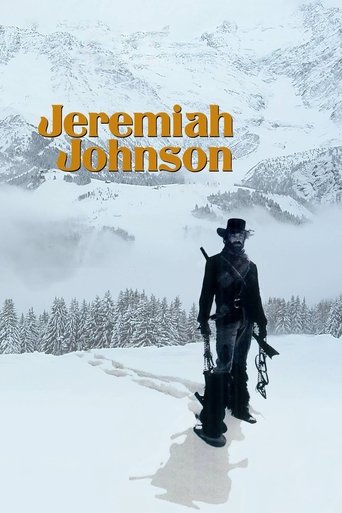
Jeremiah Johnson (1972)
Some say he's dead...some say he never will be.
While slowly adapting to the grueling life of a mountain man in the Rocky Mountains, Jeremiah Johnson encounters the Crow and Flathead tribes as well as hunters, trappers and settlers, all of whom call these mountains home.
- Date of release
- 1972-09-10
- TMDB
- 7.3 / 10 (747)
- Runtime
- 1h 48m
- Genres
- Western
- Director
- Sydney Pollack
Casting
- Robert Redford — Jeremiah Johnson
- Will Geer — Bear Claw
- Delle Bolton — Swan
- Josh Albee — Caleb
- Joaquín Martínez — Paints His Shirt Red
- Allyn Ann McLerie — Crazy Woman
- Stefan Gierasch — Del Gue
- Richard Angarola — Chief Two-Tongues Lebeaux
- Paul Benedict — Reverend Lindquist
- Charles Tyner — Robidoux
- Jack Colvin — Lieutenant Mulvey
- Matt Clark — Qualen
Interesting facts
- Box office: $44.7M
- Budget: $3.1M
- Earned 14.4× its budget
- Based on: Mountain Man
- Filmed in: Utah
Jeremiah Johnson is a 1972 American Western film directed by Sydney Pollack and starring Robert Redford as the title character and Will Geer as "Bear Claw" Chris Lapp. It is based partly on the life of the legendary mountain man John Jeremiah Johnson, recounted in Raymond Thorp and Robert Bunker's book Crow Killer: The Saga of Liver-Eating Johnson and Vardis Fisher's 1965 novel Mountain Man.
Production
In April 1968, producer Sidney Beckerman acquired the film rights to the biographical book Crow Killer: The Saga of Liver-Eating Johnson by Raymond W. Thorp Jr. and Robert Bunker. By May 1970, the rights were acquired by Warner Bros., who assigned John Milius to write a screen adaptation.
The role of Jeremiah Johnson was originally intended for Lee Marvin and then Clint Eastwood, with Sam Peckinpah to direct. However, Peckinpah and Eastwood did not get along, so Peckinpah left and Eastwood decided to make Dirty Harry instead. Warner Bros. then stepped in and set up Milius's screenplay for Robert Redford.
Casting for the role of Swan, Johnson's wife, took three months. After auditioning for another role, actress Delle Bolton was spotted by the casting director, followed up by her participation in the UCLA School of Theatre Arts Hugh O'Brian Awards competition. Bolton then interviewed with 200 Native American women and eventually won the role, even though she herself was not Native American.
After Warner Bros. advanced Redford $200,000 to secure the film's rights for him, Warner decided that the film had to be shot on the studio's backlot due to cost constraints. Insisting that it must be shot on location in Utah, Redford and Pollack convinced the studio that this could be done at the same cost. To prepare for production, art director Ted Haworth drove over 26,000 miles to find locations.
Principal photography began in January 1971, but unexpected weather threatened production. Even after Pollack mortgaged his home to supplement the limited budget, production remained constrained. "The snows of St. George in southern Utah were terrible," said Pollack, "and we were using Cinemobiles as the lifelines. There was no way I was going to let it overrun, and Bob was a superb partner in keeping us tight.
Read on Wikipedia · Text from Wikipedia, CC BY-SA 4.0. Data from Wikidata.
Recommended
- Dances with Wolves 1990 · ★ 7.8
- The Way West 1967 · ★ 6.1
- News of the World 2020 · ★ 6.9
- Legends of the Fall 1994 · ★ 7.4
- The Cowboys 1972 · ★ 7.1
- Organ Trail 2023 · ★ 6.1
- Tall Tale: The Unbelievable Adventure 1995 · ★ 6.2
- The Call of the Wild 1972 · ★ 6.1
- 3:10 to Yuma 1957 · ★ 7.3
- True Grit 1969 · ★ 7.3
- Man in the Wilderness 1971 · ★ 6.3
- The White Buffalo 1977 · ★ 6.0