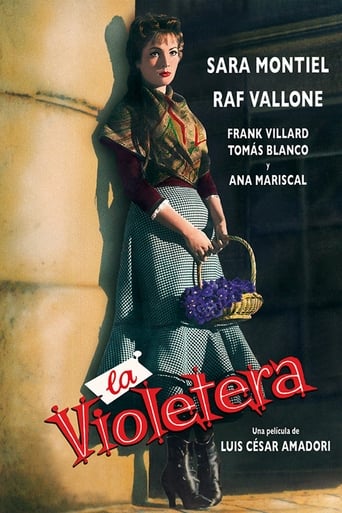
The Violet Seller (1958)
La violetera
On New Year's Eve 1899, Soledad is peddling violets in a Madrid busy street when she meets aristocrat Fernando. The couple falls in love but their different social backgrounds threatens the relationship. Fernando is under constant pressure from his older brother Alfonso who reminds him of his duties including his engagement to Magdalena, a countess. Disregarding all social conventions and scandalizing high society, Fernando sets up Soledad in a plush apartment and announces their marriage plans.
- Date of release
- 1958-04-06
- TMDB
- 6.9 / 10 (26)
- Runtime
- 1h 48m
- Genres
- Music, Drama, Romance
- Director
- Luis César Amadori
Casting
- Sara Montiel — Soledad Moreno
- Raf Vallone — Fernando
- Frank Villard — Henri Barnard
- Ana Mariscal — Magdalena
- Laura Valenzuela — Chica del Maestro
- Tomás Blanco — Alfonso
- Pastor Serrador — Carlos
- Tony Soler — Lola
- Robert Pizani — Maestro
- Aurora García Alonso — Florista
- Julia Delgado Caro — Isabel
- Blanca Suárez — Cantante
Interesting facts
The Violet Seller, better known under its Spanish title La Violetera, is a 1958 Spanish–Italian historical jukebox musical film produced by Benito Perojo, directed by Luis César Amadori and starring Sara Montiel, Raf Vallone, Frank Villard, Tomás Blanco and Ana Mariscal.
Production
After the unexpected success of Montiel's singing leading role in The Last Torch Song, a low-budget musical film that became a blockbuster, in June 1957 she signed with producer Benito Perojo a lavish contract to make four films in three years, being the first of them The Violet Seller, a large-budget international co-production musical film that was initially intended for Carmen Sevilla.
Jesús María de Arozamena wrote the script and the dialogues of the film based on the plot lines written by himself and Manuel Villegas López and adapted by André Tabet. Following the formula that proved successful in The Last Torch Song, composers Juan Quintero and Gregorio García Segura arranged a list of cuplés, made famous at the late nineteenth century and early twentieth century by singers with high-pitched voices like Raquel Meller, to fit…
Quintero also composed and conducted the film score and the songs were recorded at the Hispavox studios in Madrid. Joaquín Esparza designed the costumes. Humberto Cornejo and Spanish haute couture firms Vargas Ochagavía and Marbel dressed Montiel. Vargas Ochagavía also dressed Mariscal and Cornejo also provided the general wardrobe.
Principal photography began in November 1957 under the direction of Luis César Amadori, and took place at CEA Studios in Madrid where the full-scale period sets were constructed under the art direction of Enrique Alarcón. These included, among others, the full-scale sets of the Calle de Alcalá in front of the Apolo Theatre, a sumptuous ballroom with a full orchestra, the popular café-concert hall and those resembling the famous Lhardy and Maxim's…
As usual in those days, the filming was done without recording live sound, so the dialogues, the soundtrack and the sound effects were added during post-production. For the original language version, Spanish actors were dubbed by themselves and foreigners were dubbed by Spanish voice actors. On 26 February 1958, Montiel flew back to the United States after completing all her work in the film.
Read on Wikipedia · Text from Wikipedia, CC BY-SA 4.0. Data from Wikidata.
Recommended
- Blind 2017 · ★ 6.1
- Desire 2017 · ★ 6.0
- Dreams 2025 · ★ 6.1
- Tear This Heart Out 2008 · ★ 7.9
- Dot the I 2003 · ★ 6.0
- Tell Me Softly 2025 · ★ 6.3
- Boulevard 2026 · ★ 7.4
- Tell Me When 2020 · ★ 6.5
- The Last Time I Saw Paris 1954 · ★ 6.1
- Camila 1984 · ★ 7.2
- Killer Heat 2024 · ★ 5.8
- Fire with Fire 1986 · ★ 6.2