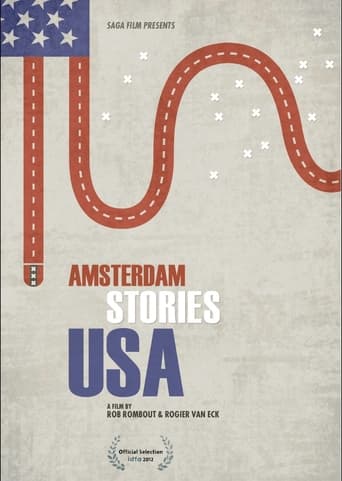
Amsterdam Stories USA (2012)
Fifteen towns in North America bear the name of the Dutch capital. From east to west, from New York, once Nieuw Amsterdam, to California, Rogier van Eck and Rob Rombout, two filmmakers of Dutch descent, link them by following that one name. Like an open sesame, it opens up small-town America, its reality and its imagination: sheriffs, poets, cowboys, a Vietnam DJ, a civil-rights veteran. An unfamiliar, intimate, sometimes strange America, in which the filmmakers are protagonists among others. Six hours, in four chapters: East, South, Midwest, West.
- Date of release
- 2012-11-19
- TMDB
- 8.0 / 10 (1)
- Runtime
- 6h 0m
- Genres
- Documentary
- Director
- Rogier Van Eck, Rob Rombout
Casting
- Timothy S. Jacobson — Self
- Russell Banks — Self
- Elinor Ruth Tatum — Self
- Adrian Cronauer — Self
- Myron Mixon — Self
- Ray Bassett — Self
- Charles Evers — Self
- Edgar Oliver — Self
- Michael Botwinick — Self
Interesting facts
- Awards: 2 · Nominations: 1. Including: IndieLisboa Audience Award; Grand Prize of the International Festival of Ethnological Film
Amsterdam Stories USA is a 2012 documentary film and road movie directed by Dutch filmmakers Rob Rombout and Rogier van Eck. It was produced by Hubert Toint and Jean-Jacques Neira of Belgium-based film production company, Saga Film. The premiere was aired in Amsterdam at the International Documentary Film Festival Amsterdam in November 2012 and at Bozar in January 2013.
Background
The idea of Amsterdam Stories USA was spawned when the filmmakers presented another film, Amsterdam via Amsterdam, in the United States. They noticed fifteen other Amsterdams in the country and when they lined them up on a map, they formed a linear route from coast to coast. They decided they would shoot a road movie capturing the same.
Rombout and van Eck, while playing themselves, travel by car around the United States, making fifteen stops at different towns, villages, and cities that have or have had the name Amsterdam. Whereas there is not much in common among these places, they are all similar in origin having been founded by Dutch explorers. The film draws an imaginary geography linking Amsterdam to Amsterdam landscapes with the way of life of the people who occupy them.
The cinematography, by Benjamin Wolf, used a Canon 5D digital camera and employed close-up shooting. Blur was introduced in their images where they would interview a speaker, make a close-up shot, and finish with a tracking shot from their moving car, drowning the subject into a blur. In terms of lighting and staging, interviewees were put in a semi-dark environment and near the camera for close-up filming.
The filmmakers were partly mentored by Russell Banks who met them in Ohio. Banks opined that the documentary would change its audience's personality and view of America and challenged the directors to choose images that could reveal the lives, needs, and fears of the people they filmed. The fifty stories successfully met this challenge thanks to their characteristic balance between information and emotion.
Rob Rombout's work on the movie played a significant role in bolstering his career as a documentary filmmaker. The film showcased Rombout's storytelling abilities and his talent for uncovering compelling narratives in seemingly ordinary locations. The documentary's success allowed Rombout to establish a reputation for creating thought-provoking, visually engaging, and thematically rich films.
Read on Wikipedia · Text from Wikipedia, CC BY-SA 4.0. Data from Wikidata.
Recommended
- To Kill a Tiger 2023 · ★ 7.6
- The Curious Birth of Benjamin Button 2009 · ★ 7.0
- Los Angeles Plays Itself 2004 · ★ 7.6
- You Can See Everything 2026 · ★ 8.8
- As I Was Moving Ahead Occasionally I Saw Brief Glimpses of Beauty 2000 · ★ 7.8
- Oasis: Don't Look Back in Anger 2026 · ★ 7.0
- Sherman's March 1986 · ★ 6.3
- Charlie: The Life and Art of Charles Chaplin 2003 · ★ 7.0
- 28 Up 1985 · ★ 7.5
- Rolling Thunder Revue: A Bob Dylan Story by Martin Scorsese 2019 · ★ 7.0
- Live Aid 1985 · ★ 7.8
- The Matrix Revisited 2001 · ★ 6.9