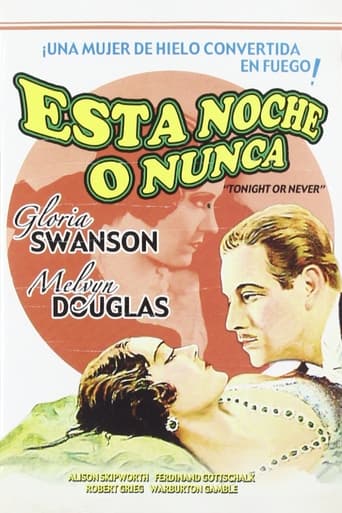
Esta noche o nunca (1931)
Tonight or Never
La húngara Nella Vago (Gloria Swanson) es una diva de ópera cuyo agente insiste en que sus representaciones carecen de pasión, una situación que sólo podría cambiar si la propia Vago tuviera una verdadera experiencia amorosa. En un viaje de vuelta a Budapest, Vago descubre que su novio, el Conde Albert von Granac, tiene una aventura. El ánimo y la titubeante carrera de Vago recibirán entonces un gran impulso gracias a la relación de la diva con el apuesto Jim Fletcher (Melvyn Douglas). (FILMAFFINITY)
- Fecha de estreno
- 1931-01-04
- TMDB
- 6.2 / 10 (10)
- Duración
- 1 h 20 min
- Géneros
- Comedia, Romance
- Director
- Mervyn LeRoy
Reparto
- Gloria Swanson — Nella Vago
- Melvyn Douglas — Jim Fletcher
- Alison Skipworth — Marchesa Bianca San Giovanni
- Ferdinand Gottschalk — Rudig
- Boris Karloff — Waiter
- Robert Greig — Conrad
- Warburton Gamble — Count Albert von Gronac
- Greta Meyer — Emma
- J. Carrol Naish — Radio Announcer
Curiosidades
Tonight or Never is a 1931 American pre-Code comedy film directed by Mervyn LeRoy and starring Gloria Swanson, Melvyn Douglas and Boris Karloff. The film is inspired by the Hungarian play of the same name, written by Lili Hatvany and performed on Broadway between November 1930 and June 1931. The title is derived from the name of a perfume by Offenthal, released in 1927.
Production
The film is based on the Hungarian play of the same name, written by Lili Hatvany, which was performed on Broadway between November 18, 1930 and June 1931. In the film, Melvyn Douglas, Ferdinand Gottschalk, Robert Greig, Greta Meyer and Warburton Gamble re-created their stage roles. In June 1931, Adela Rogers St. Johns was assigned to write the screenplay. A month later, she was replaced with Sheridan Gibney, who was eventually replaced as well.
Joseph Schenck cast Gloria Swanson to play the lead role, believing it would help her recover from a career slump. The film was the only one of Swanson's early sound films in which she did not sing, despite playing an opera singer. The film marked Douglas' screen debut.
The Hays Office strongly objected to the film and demanded several cuts. The scene thought to be the most vulgar was the love scene between Nella and Jim. A staff member commented: "This scene was one of the most offensive, if not the most offensive—in my recollection." The film was permitted a release in 1931, but as enforcement of the Motion Picture Production Code commenced in 1934, requests for re-releases in 1935 and 1937 were rejected.
Leer en Wikipedia · Texto de Wikipedia, CC BY-SA 4.0. Datos de Wikidata.
Recomendadas
- ¿Y qué tendrá que ver el amor? 2023 · ★ 6.1
- Tú la letra, yo la música 2007 · ★ 6.5
- El multimillonario 1960 · ★ 6.4
- El amor está en el aire 2023 · ★ 6.2
- Amor Bodas y Otros Desastres 2020 · ★ 6.0
- Te quiero otra vez 1940 · ★ 7.2
- Una familia con clase 2008 · ★ 6.5
- Cómo casarse con un millonario 1953 · ★ 6.8
- Consejera matrimonial 2001 · ★ 5.9
- La viuda alegre 1934 · ★ 6.8
- La chica de la bicicleta 2013 · ★ 5.9
- Ella y sus maridos 1964 · ★ 7.1