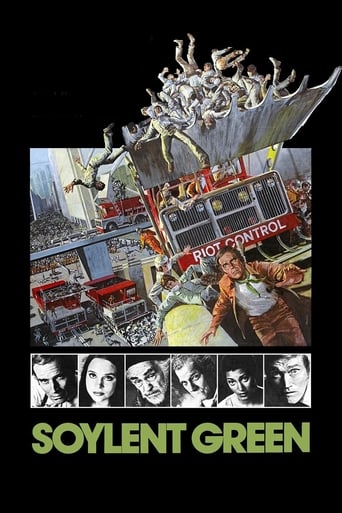
Soylent Green (1973)
It's the year 2022. People are still the same. They'll do anything to get what they need. And they need Soylent Green.
In the year 2022, overcrowding, pollution, and resource depletion have reduced society’s leaders to finding food for the teeming masses. The answer is Soylent Green.
- Date of release
- 1973-04-18
- TMDB
- 6.9 / 10 (1539)
- Runtime
- 1h 37m
- Genres
- Science Fiction, Crime, Mystery
- Director
- Richard Fleischer
Casting
- Charlton Heston — Detective Robert Thorn
- Leigh Taylor-Young — Shirl
- Chuck Connors — Tab Fielding
- Joseph Cotten — William R. Simonson
- Brock Peters — Chief Hatcher
- Paula Kelly — Martha Phillips
- Edward G. Robinson — Sol Roth
- Stephen Young — Gilbert
- Mike Henry — Kulozik
- Lincoln Kilpatrick — The Priest
- Roy Jenson — Donovan
- Leonard Stone — Charles
Interesting facts
- Box office: $3.6M
- Budget: $4M
- Earned 0.9× its budget
- Based on: Make Room! Make Room!
- Awards: 1 · Nominations: 0. Including: Saturn Award for Best Science Fiction Film
Soylent Green is a 1973 American dystopian thriller film directed by Richard Fleischer, and starring Charlton Heston, Leigh Taylor-Young, and Edward G. Robinson in his final film role. It is loosely based on the 1966 science-fiction novel Make Room! Make Room! by Harry Harrison, with a plot that combines elements of science fiction and a police procedural. The story follows a murder investigation in a dystopian future of dying oceans and a year-round heat wave caused by the greenhouse effect, with the resulting pollution, depleted resources, poverty, crime, and overpopulation.
Production
The screenplay was based on Harry Harrison's novel Make Room! Make Room! (1966), which was set in the year 1999 with the theme of overpopulation and overuse of resources leading to increasing poverty, food shortages, and social disorder. Harrison was contractually denied control over the screenplay and was not told during negotiations that Metro-Goldwyn-Mayer was buying the film rights.
While the book refers to "soylent steaks" (made from soy and lentil), it makes no reference to "Soylent Green", the processed food rations depicted in the film. The book's title was not used for the movie on grounds that it might have confused audiences into thinking it was a big-screen version of Make Room for Daddy.
This was the 101st and final film in which Edward G. Robinson appeared; he died of bladder cancer on January 26, 1973, two months after the completion of filming. In his book The Actor's Life: Journal 1956–1976, Charlton Heston wrote, "He knew while we were shooting, though we did not, that he was terminally ill. He never missed an hour of work, nor was late to a call. He never was less than the consummate professional he had been all his life.
The film's opening sequence, depicting America becoming more crowded with a series of archive photographs set to music, was created by filmmaker Charles Braverman. The "going home" score in Solomon Roth (Robinson)'s death scene was conducted by Gerald Fried and consists of the main themes from Symphony No. 6 ("Pathétique") by Pyotr Ilyich Tchaikovsky, Symphony No.
Read on Wikipedia · Text from Wikipedia, CC BY-SA 4.0. Data from Wikidata.
Recommended
- Circle 2015 · ★ 6.0
- The Return of Doctor X 1939 · ★ 6.0
- The Blue Gardenia 1953 · ★ 6.5
- Murder in Three Acts 1986 · ★ 6.0
- An Inspector Calls 2015 · ★ 7.4
- The Mirror Crack'd 1980 · ★ 6.1
- The Thirteenth Floor 1999 · ★ 7.1
- Batman: The Dark Knight Returns, Part 1 2012 · ★ 7.7
- Murder She Said 1961 · ★ 7.3
- The Murders in the Rue Morgue 1986 · ★ 5.9
- The End of Oak Street 2026 · ★ 7.0
- Aurora Teagarden Mysteries: An Inheritance to Die For 2019 · ★ 7.2