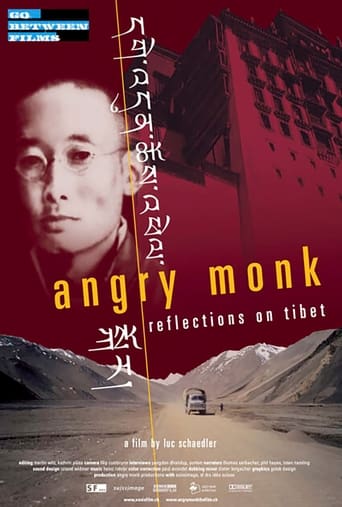
Angry Monk - Reflections on Tibet (2005)
The film film tells the fascinating story of Tibetan monk Gendun Choephel whose robes ultimately proved to be too constricting for his imagination.
Schaedler's film tells the fascinating story of Tibetan monk Gendun Choephel whose robes ultimately proved to be too constricting for his imagination and intellect. Born in 1903, Choephel left an indelible mark on Tibetan culture and became an icon for young Tibetans today. Because of his political views he was persecuted by the Tibetan government and died a broken man in 1951. The film follows in the footsteps of the rebel monk whose intellect challenged the ancient traditions of old Tibet. Journeying through Tibet and India, “Angry Monk” provides a vivid picture of Tibet that is in refreshing contrast to its often idealized and esoteric image.
- Date of release
- 2005-09-01
- TMDB
- 9.5 / 10 (2)
- Runtime
- 1h 37m
- Genres
- Documentary
- Director
- Luc Schaedler
Casting
- Golok Jigme — self
- Alak Yongtsin — self
- Tashi Tsering — self
- Jamyang Norbu — self
- Yudrung Gya — self
- Hortsang Jigme — self
Interesting facts
- Awards: 0 · Nominations: 1
Angry Monk: Reflections on Tibet is a 2005 Swiss documentary film directed by Luc Schaedler. It traces the life of the Tibetan monk, scholar and writer Gendün Chöphel (1903–1951), whose critical writings challenged the religious and political establishment of his time, and uses his biography as a way into the history of 20th-century Tibet and its present. The film was produced as part of a doctoral dissertation in visual anthropology at the University of Zurich and screened in the World Cinema Documentary Competition of the 2006 Sundance Film Festival.
Background and production
Schaedler, who studied visual anthropology at the University of Zurich, had previously made the documentary Made in Hong Kong (1997) as his master's thesis. Angry Monk was his doctoral project, supervised by the anthropologist Michael Oppitz; according to the university's journal it was the first doctoral dissertation at the University of Zurich to take the form of a film.
The scenes in Tibet were shot without permission from the Chinese authorities by a two-person crew, Schaedler and cinematographer Filip Zumbrunn, who posed as tourists. The film was shot on mini-DV and transferred to 35 mm film. Schaedler told Le Temps that Chöphel served him as "a kind of guide, a key to understanding the real Tibet".
Read on Wikipedia · Text from Wikipedia, CC BY-SA 4.0. Data from Wikidata.
Recommended
- Fuck 2006 · ★ 6.4
- As I Was Moving Ahead Occasionally I Saw Brief Glimpses of Beauty 2000 · ★ 7.8
- Directed by John Ford 1971 · ★ 7.0
- To Kill a Tiger 2023 · ★ 7.6
- Come See Me in the Good Light 2025 · ★ 7.1
- Seduced and Abandoned 2013 · ★ 6.2
- Evil Influencer: The Jodi Hildebrandt Story 2025 · ★ 6.2
- Girl Model 2011 · ★ 6.5
- McQueen 2018 · ★ 7.4
- The U.S. vs. John Lennon 2006 · ★ 6.6
- 21 Up 1977 · ★ 7.4
- 35 Up 1991 · ★ 7.6