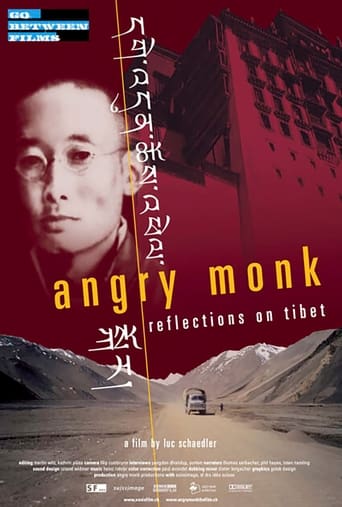
Angry Monk - Monaco arrabbiato: Riflessioni sul Tibet (2005)
Angry Monk - Reflections on Tibet
La storia di Gendun Choephel (1903-51), un monaco tibetano ribelle che si trasferisce in India come un vagabondo e torna in Tibet come uno straniero.
La storia di Gendun Choephel (1903-51), un monaco tibetano ribelle che si trasferisce in India come un vagabondo e torna in Tibet come uno straniero. Gendun Choephel viene arrestato dal governo tibetano per le sue idee politiche, accusato di ribellione e messo in prigione. Muore da uomo distrutto nel 1951. Il film segue le tracce lasciate dal monaco ribelle in Tibet e in India. Attraverso conversazioni con vecchi testimoni contemporanei e giovani tibetani, il film sviluppa un'emozionante contro-immagine del Tibet mistificato.
- Data di uscita
- 2005-09-01
- TMDB
- 9.5 / 10 (2)
- Durata
- 1 h 37 min
- Generi
- Documentario
- Regista
- Luc Schaedler
Cast
- Golok Jigme — self
- Alak Yongtsin — self
- Tashi Tsering — self
- Jamyang Norbu — self
- Yudrung Gya — self
- Hortsang Jigme — self
Curiosità
- Premi: 0 · Candidature: 1
Angry Monk: Reflections on Tibet is a 2005 Swiss documentary film directed by Luc Schaedler. It traces the life of the Tibetan monk, scholar and writer Gendün Chöphel (1903–1951), whose critical writings challenged the religious and political establishment of his time, and uses his biography as a way into the history of 20th-century Tibet and its present. The film was produced as part of a doctoral dissertation in visual anthropology at the University of Zurich and screened in the World Cinema Documentary Competition of the 2006 Sundance Film Festival.
Background and production
Schaedler, who studied visual anthropology at the University of Zurich, had previously made the documentary Made in Hong Kong (1997) as his master's thesis. Angry Monk was his doctoral project, supervised by the anthropologist Michael Oppitz; according to the university's journal it was the first doctoral dissertation at the University of Zurich to take the form of a film.
The scenes in Tibet were shot without permission from the Chinese authorities by a two-person crew, Schaedler and cinematographer Filip Zumbrunn, who posed as tourists. The film was shot on mini-DV and transferred to 35 mm film. Schaedler told Le Temps that Chöphel served him as "a kind of guide, a key to understanding the real Tibet".
Leggi su Wikipedia · Testo da Wikipedia, CC BY-SA 4.0. Dati da Wikidata.
Consigliati
- Sedotti e abbandonati 2013 · ★ 6.2
- Fuck 2006 · ★ 6.4
- To Kill a Tiger 2023 · ★ 7.6
- U.S.A. contro John Lennon 2006 · ★ 6.6
- As I was moving ahead occasionally I saw brief glimpses of beauty 2000 · ★ 7.8
- Diretto da John Ford 1971 · ★ 7.0
- The Class of ‘92 2013 · ★ 7.1
- Sergio Leone - L'italiano che inventò l'America 2022 · ★ 7.4
- Bruce Lee: la maledizione del drago 1993 · ★ 7.2
- Charlie: The Life and Art of Charles Chaplin 2003 · ★ 7.0
- Naqoyqatsi 2002 · ★ 6.2
- Harry Dean Stanton: Partly Fiction 2013 · ★ 6.9