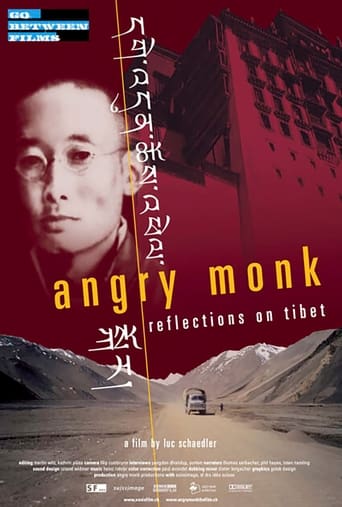
Angry Monk - Reflections on Tibet (2005)
Schaedler's film tells the fascinating story of Tibetan monk Gendun Choephel whose robes ultimately proved to be too constricting for his imagination and intellect. Born in 1903, Choephel left an indelible mark on Tibetan culture and became an icon for young Tibetans today. Because of his political views he was persecuted by the Tibetan government and died a broken man in 1951. The film follows in the footsteps of the rebel monk whose intellect challenged the ancient traditions of old Tibet. Journeying through Tibet and India, “Angry Monk” provides a vivid picture of Tibet that is in refreshing contrast to its often idealized and esoteric image.
- 개봉일
- 2005-09-01
- TMDB
- 9.5 / 10 (2)
- 상영 시간(분)
- 1시간 37분
- 장르
- 다큐멘터리
- 감독
- Luc Schaedler
출연진
- Golok Jigme — self
- Alak Yongtsin — self
- Tashi Tsering — self
- Jamyang Norbu — self
- Yudrung Gya — self
- Hortsang Jigme — self
흥미로운 사실
- 수상: 0 · 노미네이트: 1
Angry Monk: Reflections on Tibet is a 2005 Swiss documentary film directed by Luc Schaedler. It traces the life of the Tibetan monk, scholar and writer Gendün Chöphel (1903–1951), whose critical writings challenged the religious and political establishment of his time, and uses his biography as a way into the history of 20th-century Tibet and its present. The film was produced as part of a doctoral dissertation in visual anthropology at the University of Zurich and screened in the World Cinema Documentary Competition of the 2006 Sundance Film Festival.
Background and production
Schaedler, who studied visual anthropology at the University of Zurich, had previously made the documentary Made in Hong Kong (1997) as his master's thesis. Angry Monk was his doctoral project, supervised by the anthropologist Michael Oppitz; according to the university's journal it was the first doctoral dissertation at the University of Zurich to take the form of a film.
The scenes in Tibet were shot without permission from the Chinese authorities by a two-person crew, Schaedler and cinematographer Filip Zumbrunn, who posed as tourists. The film was shot on mini-DV and transferred to 35 mm film. Schaedler told Le Temps that Chöphel served him as "a kind of guide, a key to understanding the real Tibet".
위키백과에서 더 읽기 · 텍스트 출처: 위키백과, CC BY-SA 4.0. 데이터 출처: Wikidata.
추천
- 사랑받고 내쳐진 2013 · ★ 6.2
- Fuck 2006 · ★ 6.4
- 호랑이를 잡기 위해 2023 · ★ 7.6
- 존 레논 컨피덴셜 2006 · ★ 6.6
- Directed by John Ford 1971 · ★ 7.0
- 우연히 나는 아름다움의 섬광을 보았다 2000 · ★ 7.8
- 클래스 오브 92 2013 · ★ 7.1
- 찰리 채플린의 인생, 그리고 예술 2003 · ★ 7.0
- The Curse of the Dragon 1993 · ★ 7.2
- 해리 딘 스탠턴의 초상 2013 · ★ 6.9
- 나코이카시 2002 · ★ 6.2
- 배터드 바스타즈 오브 베이스볼 2014 · ★ 7.4