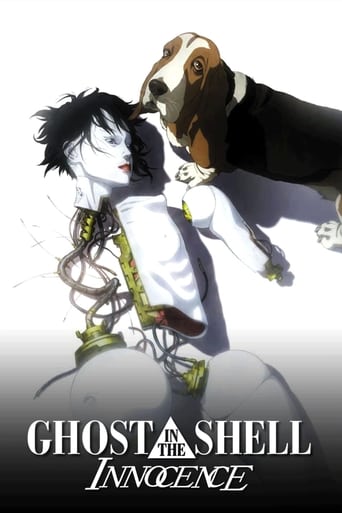
Ghost in the Shell 2: Innocence (2004)
イノセンス
When machines learn to feel, who decides what is human...
Cyborg detective Batou is assigned to investigate a series of murders committed by gynoids—doll-like cyborgs, which all malfunctioned, killed, then self-destructed afterwards. The brains of the gynoids initialize in order to protect their manufacturer's software, but in one gynoid, which Batou himself neutralized, one file remains: a voice speaking the phrase "Help me."
- Date of release
- 2004-03-06
- TMDB
- 7.4 / 10 (1049)
- Runtime
- 1h 40m
- Genres
- Animation, Drama, Science Fiction
- Director
- Mamoru Oshii
- Collection
- Ghost in the Shell Collection
Casting
- Atsuko Tanaka — Motoko Kusanagi (voice)
- Akio Otsuka — Batou (voice)
- Koichi Yamadera — Togusa (voice)
- Tamio Ohki — Section 9 Department Chief Aramaki (voice)
- Yutaka Nakano — Ishikawa (voice)
- Hiroaki Hirata — Koga (voice)
- Masaki Terasoma — Azuma (voice)
- Sumi Mutoh — Mysterious Woman (voice)
- Yuzuru Fujimoto — Criminal (voice)
- Sukekiyo Kameyama — Rin (voice)
- Ryuji Nakagi — Wakabayashi (voice)
- Fumihiko Tachiki — Bodyguard (voice)
Interesting facts
- Box office: $9.8M
- Budget: $20M
- Earned 0.5× its budget
- Based on: Ghost in the Shell
- Awards: 2 · Nominations: 1. Including: Animation Kobe Theatrical Film Award; Nihon SF Taisho Award
Ghost in the Shell 2: Innocence, known in Japan as just Innocence , is a 2004 Japanese animated cyberpunk film written and directed by Mamoru Oshii. The film serves as a standalone sequel to Ghost in the Shell (1995), and is based on the 1989-91 manga of the same name by Masamune Shirow, loosely adapting the manga chapter "Robot Rondo".
Production
Innocence had a production budget of approximately $20 million (approximately 2 billion yen). To raise the sum, Production I.G studio's president, Mitsuhisa Ishikawa, asked Studio Ghibli's president, Toshio Suzuki, to co-produce. Polygon Pictures produced the 3DCG in the film.
On the origins of the movie, director Mamoru Oshii says he didn't envision it solely as a sequel to Ghost in the Shell. He said, "I had a dozen ideas, linked to my views on life, my philosophy, that I wanted to include in this film ...
Oshii traveled the world in order to find inspirations for the film. Oshii based the appearance on the dolls created by Hans Bellmer he saw at the International Center of Photography in New York. He credited Jean-Luc Godard for the idea of including quotes by other authors: "[The texts] ... give a certain richness to cinema because the visual is not all there is. Thanks to Godard, the spectator can concoct his own interpretation ...
Oshii noted his attention to detail might be particularly Japanese: "I get absorbed in the finer points – like what the back of a bottle label looks like when you see it through the glass [demonstrates with a bottle of mineral water]. That's very Japanese, I suppose.
The dog Gabriel, looking once more like the only "real" being, makes a key appearance, as in many of Oshii's movies. A scene with Batou feeding his dog is echoed in Ash in Avalon (2001). He explained the reason why all his films feature a basset hound—his companion in real life: "This body you see before you is an empty shell. The dog represents my body. Human beings can be free only if they free themselves from their bodies.
Read on Wikipedia · Text from Wikipedia, CC BY-SA 4.0. Data from Wikidata.
Recommended
- Ghost in the Shell 2.0 2008 · ★ 7.4
- Ghost in the Shell: Arise - Border 2: Ghost Whispers 2013 · ★ 7.0
- Ghost in the Shell: Arise - Border 4: Ghost Stands Alone 2014 · ★ 6.9
- Ghost in the Shell 1995 · ★ 7.9
- 009-1: The End of the Beginning 2013 · ★ 5.9
- Ghost in the Shell: Stand Alone Complex 2nd GIG - Individual Eleven 2006 · ★ 7.5
- Battle Angel 1993 · ★ 6.8
- Ghost in the Shell: Arise - Border 1: Ghost Pain 2013 · ★ 7.0
- Ghost in the Shell: Arise - Border 3: Ghost Tears 2014 · ★ 6.8
- Mobile Suit Gundam SEED FREEDOM 2024 · ★ 7.1
- Ghost in the Shell: SAC_2045 Sustainable War 2021 · ★ 6.8
- Mardock Scramble: The First Compression 2010 · ★ 6.9