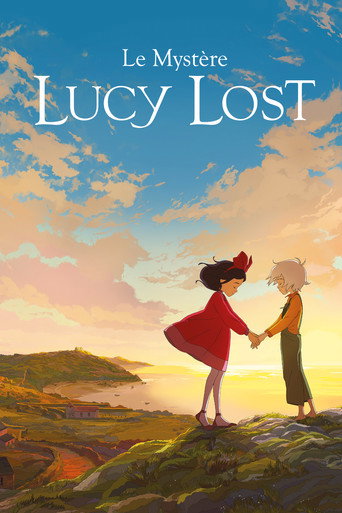
Le Mystère Lucy Lost (2026)
Set in 1915 in the Isles of Scilly just off the Cornish coast, a young girl named Lucy is raised by a clan of fishermen she knows not to be hers. However, she remembers little else about her past, and as the Great War rages down on the continent, a chance encounter with the mysterious girl her own age soon helps Lucy put back the pieces of her own life’s story and come to better understand her place in the world.
- Data di uscita
- 2026-10-28
- TMDB
- 8.0 / 10 (1)
- Durata
- 1 h 25 min
- Generi
- Avventura, Animazione, Famiglia, Fantasy, Guerra
- Regista
- Olivier Clert
Cast
- Charlie Rosenzweig — Lucy (voice)
- Zach Valentin-Dattas — Alfie (voice)
- Jessica Monceau — Mary (voice)
- Quentin Faure — Jim (voice)
- Keanu Peyran — Zeb (voice)
- Léonie Didier-Chiara — Elizabeth (voice)
- Haïly Yssembourg Da Cunha — Polly (voice)
- Rafael Didier-Chiara — Kenny (voice)
- Gustave Briere — Willy (voice)
- Benjamin Penemaria — Dave (voice)
- Nicolas Marié — Mr Beagley (voice)
- Leslie Lipkins — Miss Nightingale (voice)
Curiosità
- Basato su: Listen to the Moon
Lucy Lost is a 2026 French animated mystery historical film, directed by Olivier Clert and produced by Xilam Animation. It was written by Clert and Helen Blakeman.
Production
Marc du Pontavice first read Listen to the Moon in 2017, when he was having a drink with an artist Xilam collaborated with, and he recommended it to du Pontavice and that he thought the "themes of family, love and memory against a backdrop of vivid landscapes, would translate beautifully to the screen".
Du Pontavice struggled due to its bifurcated structure, which was across two parallel narrative threads and that the crew had great difficulty adapting the story, which worked very well in the novel but was hard to translate to the screen. The original budget as a miniseries was $6 million.
The film was fully animated in a mix of traditional animation and 3D, with some parts of the animation were done at Gao Shan Pictures in Réunion in the Indian Ocean and cleanup and color were carried out at Xilam's studio in Vietnam. Olivier Clert personally created the storyboard for the entire film, single-handedly drawing and planning the staging for its 1,800 shots.
The film's team did not show the visuals to the book's author Michael Morpurgo until they had a completed animatic, which was a first animated version of the storyboard and they received a compliment from Morpurgo, who said he wished to have seen the film before he wrote the book.
The film's original score was composed by Anne-Sophie Versnaeyen; the first phase of recording took place at Studio Polyson in Montreuil. For the session, Jean-Michel Tavernier assembled a small 14-piece string section, conducted by Gisèle Gérard-Tolini, alongside a 6-piece woodwind group and an 8-piece brass section.
Leggi su Wikipedia · Testo da Wikipedia, CC BY-SA 4.0. Dati da Wikidata.
Consigliati
- Hilda e il Re Montagna 2021 · ★ 7.6
- Welcome to Smelliville 2021 · ★ 6.7
- Slumberland - Nel mondo dei sogni 2022 · ★ 7.2
- La principessa e il folletto 1991 · ★ 5.8
- A spasso con Willy 2019 · ★ 7.2
- La famosa invasione degli orsi in Sicilia 2019 · ★ 7.2
- A Tooth Fairy Tale 2025 · ★ 8.5
- Bionicle 2 - Le leggende di Metru Nui 2004 · ★ 5.9
- La famiglia Willoughby 2020 · ★ 7.0
- La leggenda di Zanna Bianca 1994 · ★ 6.9
- Pagemaster - L'avventura meravigliosa 1994 · ★ 6.4
- Hopper e il tempio perduto 2022 · ★ 7.2