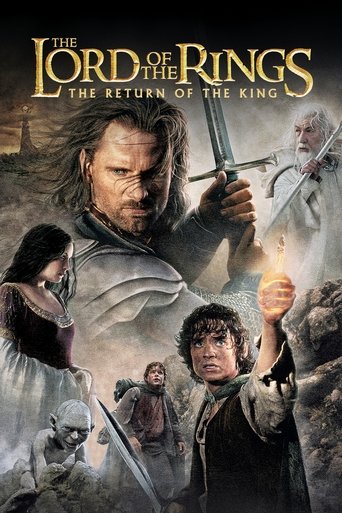
The Lord of the Rings: The Return of the King (2003)
There can be no triumph without loss. No victory without suffering. No freedom without sacrifice.
As armies mass for a final battle that will decide the fate of the world--and powerful, ancient forces of Light and Dark compete to determine the outcome--one member of the Fellowship of the Ring is revealed as the noble heir to the throne of the Kings of Men. Yet, the sole hope for triumph over evil lies with a brave hobbit, Frodo, who, accompanied by his loyal friend Sam and the hideous, wretched Gollum, ventures deep into the very dark heart of Mordor on his seemingly impossible quest to destroy the Ring of Power.
- Date of release
- 2003-12-17
- TMDB
- 8.5 / 10 (27833)
- Runtime
- 3h 21m
- Genres
- Adventure, Fantasy, Action
- Director
- Peter Jackson
- Collection
- The Lord of the Rings Collection
Casting
- Elijah Wood — Frodo
- Ian McKellen — Gandalf
- Viggo Mortensen — Aragorn
- Sean Astin — Sam
- Andy Serkis — Gollum / Smeagol
- Dominic Monaghan — Merry
- Billy Boyd — Pippin
- John Noble — Denethor
- David Wenham — Faramir
- Miranda Otto — Éowyn
- Bernard Hill — Théoden
- John Rhys-Davies — Gimli
Interesting facts
- Box office: $1.1B
- Budget: $94M
- Earned 12.1× its budget
- Based on: The Return of the King
- Filmed in: New Zealand
- Awards: 15 · Nominations: 11. Including: Academy Award for Best Picture; Academy Award for Best Director; Academy Award for Best Film Editing; Academy Award for Best Writing, Adapted Screenplay
The Lord of the Rings: The Return of the King is a 2003 epic fantasy film directed by Peter Jackson from a screenplay he wrote with Fran Walsh and Philippa Boyens. It is based on 1955's The Return of the King, the third volume of the novel The Lord of the Rings by J. R. R. Tolkien. The sequel to 2002's The Lord of the Rings: The Two Towers, the film is the final instalment in the Lord of the Rings trilogy.
Production
The production of The Lord of the Rings series was the first where three separate entries were written and shot simultaneously (excluding pick up shoots). Peter Jackson found The Return of the King the easiest of the films to make, because it contained the climax of the story.
Jackson's Middle-earth was primarily designed by Alan Lee and John Howe, who had earlier illustrated editions of Tolkien's books. It was created by Weta Workshop, who handled all the trilogy's weapons, armour, miniatures, prosthetics, and creatures; the Art Department built the sets. Richard Taylor headed Weta, while Grant Major and Dan Hennah organised the planning and building.
The city of Minas Tirith, glimpsed briefly in both the previous two films, is seen fully in this film, and with it the Gondorian civilisation. The enormous soundstage was built at Dry Creek Quarry, outside Wellington, from the Helm's Deep set. That set's gate became Minas Tirith's second, while the Hornburg exterior became that of the Extended Edition's scene where Gandalf confronts the Witch-king.
The Citadel's exterior was in the Stone Street Studios backlot, using forced perspective. It contained the withered White Tree, built from polystyrene by Brian Massey and the Greens Department with real branches, influenced by ancient and gnarled Lebanese olive trees.
Minas Morgul, the Staircase and Tower of Cirith Ungol as well as Shelob's Lair were designed by Howe, with the Morgul road using forced perspective into a bluescreened miniature. Howe's design of Minas Morgul was inspired from the experience of having a wisdom tooth pulled out: in the same way, the Orcs have put their twisted designs on to a former Gondorian city.
Read on Wikipedia · Text from Wikipedia, CC BY-SA 4.0. Data from Wikidata.
Recommended
- The Lord of the Rings: The Two Towers 2002 · ★ 8.4
- The Lord of the Rings: The Fellowship of the Ring 2001 · ★ 8.5
- The Chronicles of Narnia: The Lion, the Witch and the Wardrobe 2005 · ★ 7.1
- The Lord of the Rings 1978 · ★ 6.6
- The Hobbit: The Battle of the Five Armies 2014 · ★ 7.3
- Warcraft 2016 · ★ 6.4
- The Hobbit: An Unexpected Journey 2012 · ★ 7.4
- The Hobbit: The Desolation of Smaug 2013 · ★ 7.6
- Dragonheart: Vengeance 2021 · ★ 6.9
- Ring of the Nibelungs 2004 · ★ 6.2
- Legend 1985 · ★ 6.3
- Dragonheart: Battle for the Heartfire 2017 · ★ 6.0