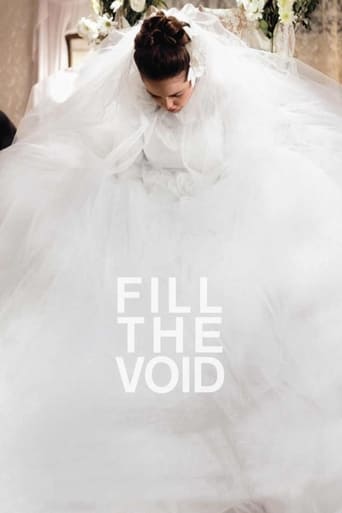
Fill the Void (2012)
למלא את החלל
Eighteen-year-old Shira is the youngest daughter of the Mendelman family. She is about to be married off to a promising young man of the same age and background. It is a dream come true, and Shira feels prepared and excited. On Purim, her twenty-eight-year-old sister, Esther, dies while giving birth to her first child, Mordechay. The pain and grief that overwhelm the family postpone Shira's promised match. Everything changes when a match is proposed to Yochay-Esther's late husband-to a widow from Belgium. Yochay feels it's too early, although he realizes that sooner or later he must seriously consider getting married again. When the girls' mother finds out that Yochay may marry the widow and move to Belgium with her only grandchild, she proposes a match between Shira and the widower. Shira will have to choose between her heart's wish and her family duty. She will find out that the void which she must choose exists only within her heart.
- Date of release
- 2012-07-01
- TMDB
- 6.2 / 10 (78)
- Runtime
- 1h 30m
- Genres
- Drama
- Director
- Rama Burshtein
Casting
- Hadas Yaron — Shira Mendelman
- Yiftach Klein — Yochay
- Renana Raz — Esther Mendelman
- Irit Sheleg — Rivka
- Razia Israeli — Aunt Hanna
- Hila Feldman — Frieda
- Ido Samuel — Yossi
Interesting facts
- Awards: 2 · Nominations: 1. Including: Ophir Award for best feature film; European Film Award for Best Cinematographer
Fill the Void is a 2012 Israeli drama film written and directed by Rama Burshtein. It focuses on life among the Haredi Jewish community in Tel Aviv, Israel. Hadas Yaron stars as Shira Mendelman, an 18-year-old girl who is pressured to marry her older sister's husband, following the death of her sister in childbirth.
Production
Fill the Void was written and directed by Rama Burshtein, who, in the course of its production, became the first Haredi Jewish woman to direct a film intended to be viewed outside of the Haredi community. In doing so, she hoped to create a greater understanding of the Haredi community, in part by dispelling the common misconceptions that women are often forced into arranged marriages; despite the differences in structure, the woman is always give…
As a people, we are thousands of years old, and we exist without that conflict of the secular and the religious. The truth is that most of us do not want to leave our communities. All of those films were always about someone either trying to get out or someone from the outside trying to get in, and it was very important for me to say that we also just exist and feel and love and struggle and hurt by ourselves, not always because we're in conflict…
In her director's notes, Burshtein wrote, "I love Jane Austen. She's romantic, intelligent, and full of humor. ... The parallel is also quite obvious in that 'Fill the Void' takes place in a world where the rules are rigid and clear. The characters are not looking for some way to burst out of that world.
Merry suggested that, regardless of cultural differences, the story is universal, due to "its themes of loss and family loyalty, not to mention the realization that life may not align with our idealized expectations". Boston Globe correspondent Peter Keough agreed that the "themes of love and loss, self-sacrifice and self-preservation" are applicable to audiences both in and outside the Haredi community.
Casting the film took a full year to complete, largely because, according to Burshtein, she "didn't know what [she] wanted". She initially considered using "regular people" with no background in acting, before realizing that "non-actors couldn't handle the complexities of their characters".
Read on Wikipedia · Text from Wikipedia, CC BY-SA 4.0. Data from Wikidata.
Recommended
- Gett: The Trial of Viviane Amsalem 2014 · ★ 7.5
- The Devil's Arithmetic 1999 · ★ 6.8
- Black or White 2015 · ★ 6.8
- Avalon 1990 · ★ 6.7
- The Miracle Worker 2000 · ★ 7.3
- Won't Back Down 2012 · ★ 6.2
- The Effect of Gamma Rays on Man-in-the-Moon Marigolds 1972 · ★ 7.3
- The Zone of Interest 2023 · ★ 7.0
- I Believe in Unicorns 2015 · ★ 6.6
- Driving Miss Daisy 1989 · ★ 7.2
- Fathers and Daughters 2015 · ★ 7.2
- The Way Back 2020 · ★ 6.6