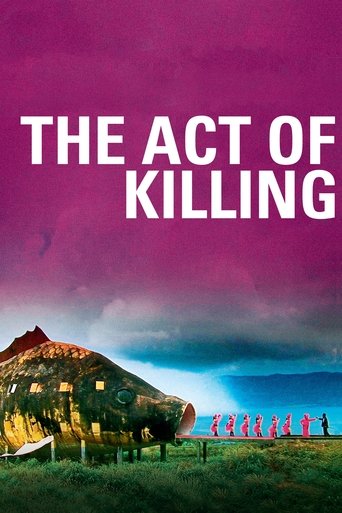
The Act of Killing (2012)
A story of killers who win and the society they build.
After befriending documentarian Joshua Oppenheimer, former Indonesian death squad leaders reenact their real-life mass killings in the style of various American film genres. As they recreate their past atrocities, the line between reality and performance blurs, exposing the lingering impact of Indonesia's 1965-66 anti-communist purge and the unsettling psychology of its perpetrators.
- Date of release
- 2012-11-01
- TMDB
- 7.7 / 10 (800)
- Runtime
- 2h 39m
- Genres
- Documentary, History
- Director
- Joshua Oppenheimer
Casting
- Anwar Congo — Self - Executioner in 1965
- Herman Koto — Self - Gangster & Paramilitary Leader
- Syamsul Arifin — Self - Governor of North Sumatra
- Ibrahim Sinik — Self - Newspaper Publisher
- Yapto Soerjosoemarno — Self - Leader of Pancasila Youth
- Safit Pardede — Self - Local Paramilitary Leader
- Jusuf Kalla — Self - Vice President of Indonesia
- Adi Zulkadry — Self - Fellow Executioner in 1965
- Suryono — Self - Anwar's Neighbor
- Haji Marzuki — Self - Member of North Sumatra Parliament
- Haji Anif — Self - Paramilitary Leader & Businessman
- Rahmat Shah — Self - Member of Parliament
Interesting facts
- Budget: $1M
- Awards: 1 · Nominations: 2. Including: European Film Award for Best Documentary
The Act of Killing is a 2012 documentary film directed by Joshua Oppenheimer, with Christine Cynn and an anonymous Indonesian co-directing. The film follows individuals who participated in the Indonesian mass killings of 1965–66, wherein alleged communists and people opposed to the New Order regime were tortured and killed, with the killers, many becoming gangsters, still in power throughout the country. The film was mostly filmed in Medan, North Sumatra, following the executioner Anwar Congo and his acquaintances as they, upon Oppenheimer's request, re-enact their killings and talk about their actions openly, also following Congo's psychological journey facing the topic.
Production
The Act of Killing came to be when Oppenheimer and co-director Christine Cynn went to a Belgian-owned palm plantation nearby Medan, where the female workers were asked to spray herbicide without adequate protective equipment; the film that came out of it, The Globalisation Tapes (2003), documents their worries on making a union against the system because their grandparents were alleged pro-communists killed during the genocide.
The film was shot mostly between 2005 and 2011. In several interviews, Oppenheimer described his feeling listening to the perpetrators as if "I'd wandered into Germany 40 years after the Holocaust only to find the Nazis still in power".
Oppenheimer handled half of the cinematography, with Lars Skree, Carlos Arango de Montis, and the Indonesian co-director doing the rest. He let the killers use the cameras to document the behind-the-scenes process of their re-enactments. Long takes were preferred to depict entire events, and the crew would not speak much as it records.
Filmed in 2009, the re-enactments were funded by the filmmakers, but some scenes were made by Congo's squad, with production values Oppenheimer called "awful". Because Oppenheimer's crew had no experience with fiction, they consulted Congo for authenticity.
Amid filming, Oppenheimer traveled to Jakarta to show the videos filmed thus far to genocide survivors and human rights advocates, who deemed his findings important and crucial to continue on. They also frequently delivered dailies and transcripts of it to National Human Rights Commissioner Stanley Prasetyo, who helped with interview ideas.
Read on Wikipedia · Text from Wikipedia, CC BY-SA 4.0. Data from Wikidata.
Recommended
- Cover-Up 2025 · ★ 7.2
- Fuck 2006 · ★ 6.4
- The Look of Silence 2014 · ★ 7.8
- Evil Influencer: The Jodi Hildebrandt Story 2025 · ★ 6.2
- Seaspiracy 2021 · ★ 7.8
- Come See Me in the Good Light 2025 · ★ 7.0
- My Mom Jayne 2025 · ★ 8.0
- City of Ghosts 2017 · ★ 7.2
- JFK Revisited: Through the Looking Glass 2021 · ★ 7.0
- Audrey 2020 · ★ 7.1
- Father Soldier Son 2020 · ★ 6.5
- Citizenfour 2014 · ★ 7.7