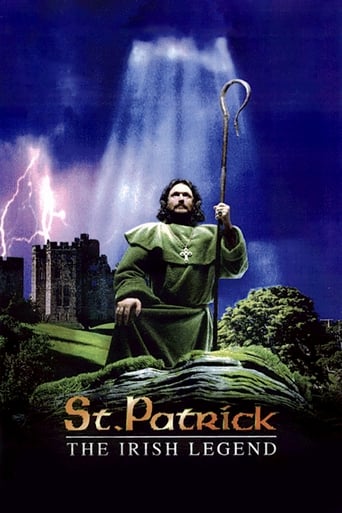
St. Patrick: The Irish Legend (2000)
A young Christian boy attends a druid worship that is attacked by invading Irish tribes. Taken captive, he is taken back to Ireland to become a slave. Enduring many hardships, he finds comfort and eventually salvation in his faith. After several years, he escapes back to England, where he joins a convent to prove his faith. His greatest desire is to return to Ireland to convert the Irish to Christianity. Years later, he is given the opportunity. Upon setting foot on the Irish soil, all snakes are aitomatically driven from the land. He then overcomes many obstacles, including disagreements with the British Cardinal (Malcolm McDowell), to fulfill his destiny and ultimately being given Sainthood.
- Date of release
- 2000-03-12
- TMDB
- 5.0 / 10 (5)
- Runtime
- 1h 40m
- Genres
- Drama, Adventure, Fantasy, History, TV Movie
- Director
- Robert Hughes
Casting
- Patrick Bergin — Patrick
- Luke Griffin — Young Patrick
- Alan Bates — Calpornius
- Susannah York — Concessa
- Malcolm McDowell — Quentin
- Eamonn Owens — Benignus
- Chris McHallem — Auxilius
- Michael Caven — Iserninus
- Stephen Brennan — Briain
- Adam Goodwin — Brother Peter
- Peter Byrne — Ship Captain
- Michael Carven
Interesting facts
St. Patrick: The Irish Legend is a 2000 television historical drama about the life of Saint Patrick, the fifth-century missionary bishop and patron saint of Ireland. Directed by Robert Hughes and starring Patrick Bergin in the title role, it was produced by the Fox Family Channel and filmed in Ireland. The film premiered on 12 March 2000. Reviewers praised its cast and Irish locations but criticised its loose treatment of history.
Production
The film was produced by the Fox Family Channel in association with Sharpmist III Ltd. and shot on location in Ireland. Lance H. Robbins was executive producer, with Morgan O'Sullivan and James Flynn as co-producers. James Mathers was the cinematographer and Terry Chiappe edited the film. Inon Zur's score featured the Irish groups the Chieftains and Clannad, and the visual effects were produced by Foundation Imaging.
To prepare for the role, Bergin read as much about the saint as he could. He later described the prayer "Saint Patrick's Breastplate" as a personal ritual, saying that performing its movements amounted to "essentially doing a kind of yoga".
Supporting actor Alan Bates was paid £30,000 for two days' work in March 1999; he thought poorly of the film but used his salary to buy a Renault he coveted.
Read on Wikipedia · Text from Wikipedia, CC BY-SA 4.0. Data from Wikidata.
Recommended
- Mary 2024 · ★ 6.3
- The Immortal Life of Henrietta Lacks 2017 · ★ 6.3
- Kings of the Sun 1963 · ★ 6.1
- Risen 2016 · ★ 6.3
- Abraham 1993 · ★ 7.2
- Welcome to Smelliville 2021 · ★ 6.7
- Strings 2004 · ★ 6.6
- Meltdown: Days of Destruction 2006 · ★ 6.0
- TalhotBlond 2012 · ★ 6.3
- Cave Rescue 2019 · ★ 5.9
- A Wrinkle in Time 2003 · ★ 6.3
- The Princess and the Goblin 1991 · ★ 5.8