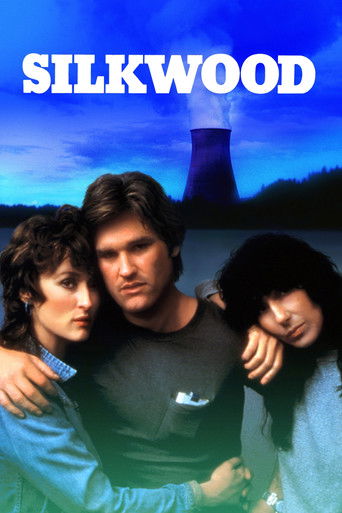
Silkwood (1983)
On November 13, 1974, Karen Silkwood, an employee of a nuclear facility, left to meet with a reporter from the New York Times. She never got there.
Like most of the people in her town, Karen Silkwood works at the local nuclear plant producing highly radioactive plutonium. Exposed one day to a lethal dose of radiation, Karen faces the blank walls of corporate indifference and denial. As her illness increases, her protest grows louder and she becomes an obvious danger to the powers that be.
- Date of release
- 1983-12-14
- TMDB
- 6.9 / 10 (374)
- Runtime
- 2h 11m
- Genres
- Drama
- Director
- Mike Nichols
Casting
- Meryl Streep — Karen Silkwood
- Kurt Russell — Drew Stephens
- Cher — Dolly Pelliker
- Craig T. Nelson — Winston
- Fred Ward — Morgan
- Diana Scarwid — Angela
- Ron Silver — Paul Stone
- Charles Hallahan — Earl Lapin
- Josef Sommer — Max Richter
- Sudie Bond — Thelma Rice
- Henderson Forsythe — Quincy Bissell
- E. Katherine Kerr — Gilda Schultz
Interesting facts
- Budget: $10M
- Filmed in: New Mexico
- Awards: 0 · Nominations: 5
Silkwood is a 1983 American biographical drama film directed by Mike Nichols, and starring Meryl Streep, Kurt Russell, and Cher. The screenplay by Nora Ephron and Alice Arlen was adapted from the book Who Killed Karen Silkwood? by Rolling Stone writer and activist Howard Kohn, which detailed the life of Karen Silkwood, a nuclear whistle-blower and a labor union activist who investigated alleged wrongdoing at the Kerr-McGee plutonium plant where she worked. In real life, her death in a car crash gave rise to a 1979 lawsuit, Silkwood v. Kerr-McGee, led by attorney Gerry Spence.
Production
Development of a film adaptation of Karen Silkwood's life spanned approximately nine years before the film began production. Executive producers Buzz Hirsch and Larry Cano, while both graduate students at the University of California, Los Angeles, became fascinated by Silkwood's story and sought to bring it to the screen. Within a year of graduating, Hirsch and Cano began developing the project. Warner Bros.
In June 1977, a 10th Circuit Court of Appeals in Denver, Colorado, agreed to hear Hirsch's appeal of Eubanks' ruling, with the Writers Guild of America West voting to lend legal assistance to Hirsch in the process, declaring they would file an amicus curiae, "arguing that Hirsch has a First Amendment right to shield his film materials from subpoena." In September that year, the 10th Circuit Court of Appeals reversed Eubanks' ruling, ordering addi…
In the fall of 1980, ABC Motion Pictures began revamping Hirsch's original project with Nora Ephron and Alice Arlen writing the screenplay. Producer Frank Yablans, though not credited on the film, was involved in the project's development and was approached by director Mike Nichols, who was hired to direct.
Meryl Streep was cast as Karen Silkwood in October 1981. Nichols cast Cher in the role of Silkwood's lesbian roommate, Dolly Pelliker, after seeing her in the Broadway production of Come Back to the 5 & Dime, Jimmy Dean, Jimmy Dean, feeling she possessed the necessary "vitality, humor and surprising depth."
The film was shot on location in Albuquerque and Los Alamos in New Mexico, and Dallas, Howe, Texas City, and Tom Bean in Texas from September 7 to November 26, 1982. Arthur Hirsch and Larry Cano were the producers of the film and received Executive Producer credits. They began working on the movie while graduate film students at UCLA. Their involvement in the making of Silkwood set a precedent in the U.S.
Read on Wikipedia · Text from Wikipedia, CC BY-SA 4.0. Data from Wikidata.
Recommended
- Pu-239 2006 · ★ 6.7
- The China Syndrome 1979 · ★ 7.1
- Panic in Year Zero! 1962 · ★ 6.3
- Night Moves 2014 · ★ 5.9
- Five 1951 · ★ 6.6
- Threads 1984 · ★ 7.7
- Bastard Out of Carolina 1996 · ★ 7.1
- Unthinkable 2010 · ★ 6.8
- Watchmen: Chapter II 2024 · ★ 7.3
- Matewan 1987 · ★ 7.4
- Clemency 2019 · ★ 6.3
- Blue Collar 1978 · ★ 7.3