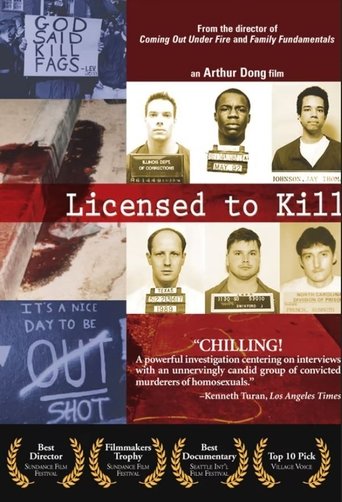
Licensed to Kill (1997)
A riveting journey into the minds of men whose contempt for homosexuals led them to murder. Attacked in 1977 by gay bashers on the streets of San Francisco, filmmaker Arthur Dong confronts murderers of gay men face-to-face in his film. He asks them directly: “Why did you do it?”
- Date of release
- 1997-01-16
- TMDB
- 4.5 / 10 (6)
- Runtime
- 1h 20m
- Genres
- Documentary
- Director
- Arthur Dong
Casting
- Donald Aldrich — Self - Killer
- Corey Burley — Self - Killer
- Raymond Childs — Self - Killer
- William Cross — Self - Killer
- Arthur Dong — Self (voice)
- Kenneth French — Self - Killer
- Jay Johnson — Self - Killer
- Jeffrey Swinford — Self - Killer
- Jason Waller — Self - Killer
Interesting facts
- Awards: 2 · Nominations: 0. Including: Sundance U.S. Directing Award: Documentary; Sundance Filmmaker Trophy Documentary
Licensed to Kill is a 1997 documentary written, directed, and produced by Arthur Dong, in which Dong, a gay man himself, interviews six inmates who committed murder for reasons related to homophobia.
Production
Included in the film are scenes from daily U.S. life showing the violence directed toward homosexuality, both specific – one neighbor attacking another; and in more general terms, such as the programs of Pat Robertson and Ralph Reed, to show the viewer how pervasive the invective towards gays had become at the time the film was made.
Dong originally had also wanted to include content regarding lesbian murders; however, none of the killers of lesbians he contacted were willing to be interviewed. While at one point footage of violence against lesbians had been edited for inclusion, Dong felt that to do so without the interviews to balance it would merely be "tokenism".
Initially, the film didn't include footage of the victims' corpses, and test audiences found themselves disturbed by their sympathetic responses to the killers. Dong stated that one of his goals with the documentary was to show that the men who committed the crimes included in the film could very easily be a next-door neighbor, but that after the test audience response, he needed balance to convey the intended message.
The film budget consisted of grants from various foundations totaling US$135,000, including a Rockefeller Foundation grant bestowed in 1995. It was presented on 16 mm film and took less than two years to produce. In June 1997, Dong stated that he intended to edit the 80-minute documentary to a 30-minute version that could be shown in high schools.
Read on Wikipedia · Text from Wikipedia, CC BY-SA 4.0. Data from Wikidata.
Recommended
- Welcome to Chechnya 2020 · ★ 7.0
- Looking for Richard 1996 · ★ 6.8
- I Am Heath Ledger 2017 · ★ 7.4
- Come See Me in the Good Light 2025 · ★ 7.1
- Scotty and the Secret History of Hollywood 2018 · ★ 6.0
- Public Speaking 2011 · ★ 7.0
- Charlie: The Life and Art of Charles Chaplin 2003 · ★ 7.0
- A Toxic Love Story 2026 · ★ 6.4
- Harmontown 2014 · ★ 6.6
- Louis Theroux: Inside the Manosphere 2026 · ★ 6.6
- Gilbert 2017 · ★ 6.7
- Avatar: The Deep Dive - A Special Edition of 20/20 2022 · ★ 7.2