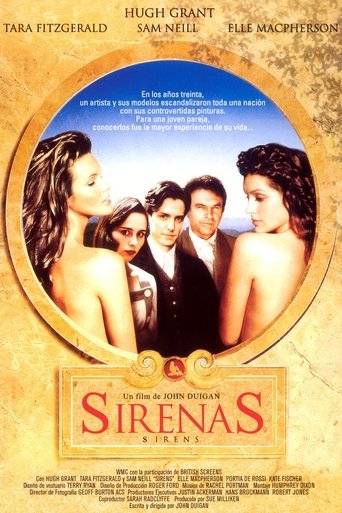
Sirenas (1994)
Sirens
En la década de 1930, un artista y sus modelos escandalizaron a una nación con sus controvertidas pinturas. Para una joven pareja, conocerlos fue la experiencia de toda una vida.
A principios de los 30, en Sidney, la jerarquía eclesiástica se escandaliza ante un grabado del célebre y libertino pintor Norman Lindsay, que muestra a una voluptuosa mujer en inequívoca postura sobre una cruz. Anthony Campion, un joven clérigo recién llegado de Inglaterra con su esposa, es el encargado de convencer a Lindsay para que no exhiba esa obra en una próxima exposición en Londres. Convertidos en huéspedes del pintor, pronto el reverendo Campion y su mujer se verán envueltos en el clima provocador y erótico que impera en el lugar.
- Fecha de estreno
- 1994-03-04
- TMDB
- 5.6 / 10 (179)
- Duración
- 1 h 34 min
- Géneros
- Comedia, Drama
- Director
- John Duigan
Reparto
- Hugh Grant — Anthony Campion
- Tara Fitzgerald — Estella Campion
- Sam Neill — Norman Lindsay
- Elle Macpherson — Sheela
- Portia De Rossi — Giddy
- Tziporah Malkah — Pru
- Pamela Rabe — Rose Lindsay
- Ben Mendelsohn — Lewis
- John Polson — Tom
- Mark Gerber — Devlin
- Julia Stone — Jane
- Ellie MacCarthy — Honey
Curiosidades
- Recaudación: 2,8 M AUD
- Premios: 0 · Nominaciones: 3
Sirens is a 1994 film, based on the life of artist and author Norman Lindsay, written and directed by John Duigan and set in Australia during the interwar period. Sirens was mostly filmed at the Norman Lindsay Gallery and Museum, Lindsay's home and studio in Faulconbridge, New South Wales and the town of Sofala near Bathurst.
Production
The film was a long-standing project of John Duigan:
The starting point was the idea of doing something on the tension between the church's teaching and the sensual side of life. I have always felt that the church's actual teachings on this issue—since I experienced it first-hand as a boy at school—reflected some biases, particularly against the place and role of women in the church, and the place of women's sensuality.
He originally pitched the project to Kennedy Miller after making Fragments of War but they passed.
Duigan said that what drew him to cast Grant: "Hugh has the capacity to be a terrific player of light comedy, in the tradition of Cary Grant and David Niven. He has the same ease and urbanity in the way he moves and talks." Grant told Farber what he brought to the character of the Anglican priest:
I kept looking at the part and wondered how I could crack it, because he was such a straitlaced character. And then I realized that if he thought he was trendy and avant-garde, that added a whole new swing to it. I see him as quite the star of his theological college, probably quite daring with his Turkish cigarettes. And I imagine that he even makes the occasional sexual reference in his conversation after a couple of glasses of sherry.
Leer en Wikipedia · Texto de Wikipedia, CC BY-SA 4.0. Datos de Wikidata.
Recomendadas
- Una estafa celestial 2021 · ★ 6.0
- Un crimen perfecto 1998 · ★ 6.6
- El contrato del dibujante 1982 · ★ 7.1
- La ambición de los Savage 2026 · ★ 7.0
- Clase 1983 · ★ 6.0
- La fiebre de los peluches Beanie 2023 · ★ 6.4
- Kinds of Kindness 2024 · ★ 6.5
- Enredos y mentiras 2017 · ★ 6.2
- La familia Jones 2010 · ★ 6.2
- CQ 2001 · ★ 5.9
- La gran caída de Igby 2002 · ★ 6.6
- Fin de semana en familia 2013 · ★ 6.3