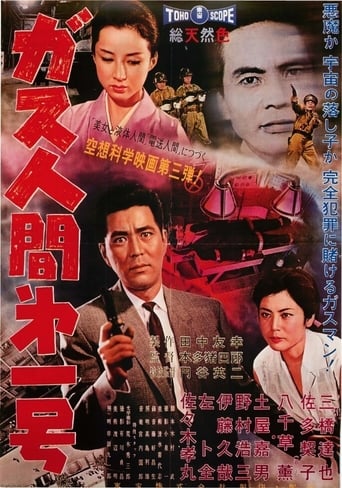
The Human Vapor (1960)
ガス人間第1号
Un bibliotecario es objeto de un experimento que sale mal y lo convierte en el "Vapor Humano". Utiliza su nuevo don para el robo de bancos y para ayudar a su novia bailarina. Buscado por la policía, y con varios crímenes a cuestas, el Vapor Humano es el enemigo público número 1 de Tokyo
- Fecha de estreno
- 1960-12-11
- TMDB
- 7.1 / 10 (29)
- Duración
- 1 h 32 min
- Géneros
- Ciencia ficción, Crimen, Suspense
- Director
- Ishiro Honda
- Colección
- 変身人間シリーズ
Reparto
- 三橋達也 — Detective Okamoto
- 八千草薫 — Fujichiyo Kasuga
- 土屋嘉男 — Mr. Mizuno
- 佐多契子 — Reporter Kyoko
- 左卜全 — Jiya
- 田島 義文 — Detective Inspector
- 伊藤久哉 — Police Scientist
- 松村達雄 — Editor Ikeda
- 村上冬樹 — Dr. Sano
- 小杉義男 — Mean Detective
- 三島耕 — Detective Fujita
- 佐々木孝丸 — Police Chief
Curiosidades
The Human Vapor is a 1960 Japanese science fiction thriller film directed by Ishirō Honda, with special effects by Eiji Tsuburaya. Produced and distributed by Toho, it is the third and final film in the Transforming Human Series, after The H-Man (1958) and The Secret of the Telegian (1960). Yoshio Tsuchiya stars as the titular character, a man transformed into a gaseous being after a scientific experiment goes awry. Kaoru Yachigusa, Tatsuya Mihashi, and Keiko Sata appear in supporting roles.
Production
The Human Vapor marked the third and final installment in the Transforming Human trilogy at Toho, following The H-Man (1958) and The Secret of the Telegian (1960). The project originated when producer Tomoyuki Tanaka acquired a story outline by American screenwriter John Meredyth Lucas, best known for his work on Star Trek and earlier B-movies.
Kimura's script deliberately reflected the turbulent socio-political climate of 1960 Japan. The Anpo protests—massive demonstrations against the revised U.S.–Japan Security Treaty—had paralyzed Tokyo in June, culminating in the cancellation of President Dwight D. Eisenhower's state visit and the resignation of Prime Minister Nobusuke Kishi.
Ishirō Honda joined the project under unusual circumstances. Initially attached to direct an aviation drama titled Today I Am in the Skies (今日も私は空にいる), Honda saw the film canceled by Toho executives. Simultaneously, Jun Fukuda—originally slated to helm The Human Vapor—departed for another assignment, prompting Tanaka to reassign Honda.
The majority of interior scenes were shot on Toho Studios soundstages in Tokyo. Exterior filming took place at two symbolically charged locations: the Bank of Japan headquarters in Chūō, Tokyo and the National Diet Library.
Cinematographer Hajime Koizumi employed low-angle tracking shots, chiaroscuro lighting, and canted angles—particularly in Dr. Sano's laboratory—to heighten psychological unease. Honda and Yoshio Tsuchiya (Mizuno) collaborated on a signature transformation gesture: the actor places his hand over his heart before dissolving, a subtle tic that became a visual motif. Tsuchiya recalled: "I asked Honda, ‘How should I disappear?'...
Leer en Wikipedia · Texto de Wikipedia, CC BY-SA 4.0. Datos de Wikidata.
Recomendadas
- Código 8 (Parte 2) 2024 · ★ 6.4
- Espacio/Tiempo 2025 · ★ 5.8
- La Señal 2007 · ★ 5.9
- Spectral 2016 · ★ 6.6
- Contención 2015 · ★ 5.9
- El resucitado 1991 · ★ 6.2
- Los últimos días del crimen 2020 · ★ 6.4
- Alarma, catástrofe 1978 · ★ 6.8
- Push 2009 · ★ 6.1
- Cazadoras de aliens 2022 · ★ 6.4
- Venganza diabólica (Maniac) 1963 · ★ 6.2
- Red de mentiras 2026 · ★ 7.5