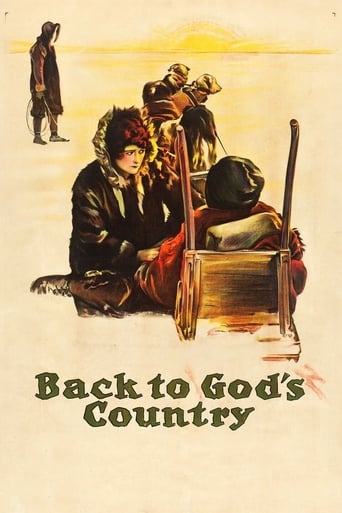
Back to God's Country (1919)
After her father is killed by an outlaw, Dolores marries Peter. While they're at sea in the Arctic, Dolores meets the ship's captain, who is the man who killed her father. The captain causes an 'accident' to happen to Peter, so Dolores is all alone and defenceless as they drop anchor in a remote harbour.
- Date of release
- 1919-10-27
- TMDB
- 6.2 / 10 (18)
- Runtime
- 1h 13m
- Genres
- Romance, Adventure, Western
- Director
- David Hartford
Casting
- Nell Shipman — Dolores LeBeau
- Charles Arling — 'Sealskin' Blake
- Wheeler Oakman — Peter Burke
- Wellington A. Playter — Capt. Rydal
- Ronald Byram — Peter Burke (Original Casting)
- William Colvin — Mountie Shot by Rydal
- Roy Laidlaw — Baptiste LeBeau, Dolores' Father
- Kewpie Morgan — Bully in Bar
- Charles Murphy — The Half-Breed
Interesting facts
Back to God's Country is a 1919 Canadian drama film directed by David Hartford based on a story by James Curwood. It is one of the earliest Canadian feature films. The film starred Canadian actress Nell Shipman who wrote the screenplay adaptation of Curwood's story. She changed the protagonist of the film from a great dane to the female lead, Dolores. Shipman also shaped her character into a heroine, who saves her husband. Curwood was infuriated with Shipman, but commercially the film was extremely successful, posting a 300 percent profit and grossing a million-and-a-half dollars.
Production
After leaving Vitagraph Studios, Nell Shipman created a contract with James Oliver Curwood in order to adapt and star in adaptations of his work. Curwood's short story Wapi the Walrus was adapted into Back to God's Country. Nell stated that the original story "was trash as a movie; a mere outline" and her adaptation increased the role of the female character, which she played.
Ernest Shipman raised funds for the film in Calgary through the Shipman Curwood Motion Picture Production Company. When filming started the company producing it was named Shipman Curwood Productions, but was renamed Curwood-Carver Productions, which was the name used in the credits.
David Hartford and Bert Van Tuyle directed the film, but only Hartford was credited. Filming occurred from 12-13 March to 31 May 1919, at a cost of $165,000 (equivalent to $2,764,592 in 2025). Shooting started at Lesser Slave Lake on 12 or 13 March 1919, and lasted two weeks before moving to Calgary and completed filming by 31 May at Kern River and San Francisco.
One scene showing Dolores mushing through "the frozen waste" was filmed at -60 degrees °F. Ronald Byram died of pneumonia during filming at Lesser Slave Lake and was replaced by Wheeler Oakman. Van Tuyle's right foot suffered from frostbite and some of his toes were amputated due to gangrene.
Cinematographer Joseph Walker used a technique he learned from Billy Bitzer, in which he opened the lens as wide as possible in order for the background to appear soft and unobtrusive compared to the dominance of the person in the foreground.
Read on Wikipedia · Text from Wikipedia, CC BY-SA 4.0. Data from Wikidata.
Recommended
- The Big Sky 1952 · ★ 6.6
- Davy Crockett and the River Pirates 1956 · ★ 6.3
- Angel and the Badman 1947 · ★ 6.4
- The Tall Men 1955 · ★ 6.4
- North West Mounted Police 1940 · ★ 6.4
- Scaramouche 1952 · ★ 7.0
- Spirit Untamed 2021 · ★ 7.2
- Last of the Dogmen 1995 · ★ 6.8
- Call of the Wild 1935 · ★ 6.3
- 3 Bad Men 1926 · ★ 7.0
- Virginia City 1940 · ★ 6.3
- The Legend of Zorro 2005 · ★ 6.1