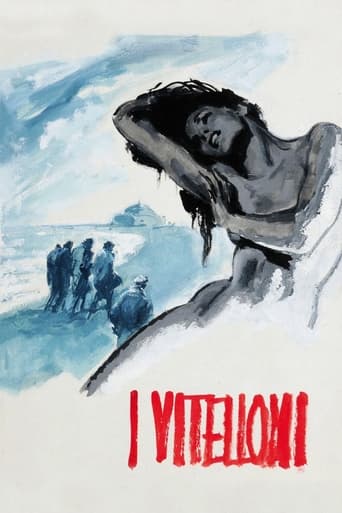
I Vitelloni (1953)
I vitelloni
A daring story of uninhibited youth!
Five young men dream of success as they drift lazily through life in a small Italian village. Fausto, the group's leader, is a womanizer; Riccardo craves fame; Alberto is a hopeless dreamer; Moraldo fantasizes about life in the city; and Leopoldo is an aspiring playwright. As Fausto chases a string of women, to the horror of his pregnant wife, the other four blunder their way from one uneventful experience to the next.
- Date of release
- 1953-09-17
- TMDB
- 7.7 / 10 (760)
- Runtime
- 1h 43m
- Genres
- Comedy, Drama
- Director
- Federico Fellini
Casting
- Franco Interlenghi — Moraldo Rubini
- Alberto Sordi — Alberto
- Franco Fabrizi — Fausto Moretti
- Leopoldo Trieste — Leopoldo Vannucci
- Riccardo Fellini — Riccardo
- Leonora Ruffo — Sandra Rubini
- Jean Brochard — Francescco Moretti
- Claude Farell — Olga
- Carlo Romano — Michele Curti
- Enrico Viarisio — Signor Rubini
- Paola Borboni — Signora Rubini
- Lída Baarová — Giulia Curti
Interesting facts
- Filmed in: Rome, Florence, Viterbo, and Lido di Ostia
- Awards: 0 · Nominations: 1
I Vitelloni is a 1953 Italian comedy drama film directed by Federico Fellini from a screenplay written by himself, Ennio Flaiano, and Tullio Pinelli. It stars Franco Interlenghi, Alberto Sordi, Franco Fabrizi, Leopoldo Trieste, and Riccardo Fellini as five young Italian men at crucial turning points in their small-town lives. Recognized as a pivotal work in Fellini's artistic evolution, the film has distinct autobiographical elements that mirror important societal changes in 1950s Italy.
Production
Having completed an early version of La Strada with co-screenwriter Tullio Pinelli in 1952, Fellini offered their "modern fairy tale" to producer Luigi Rovere, with whom he was still under contract. Rovere had solid reasons for turning it down: La Strada was in no recognizable genre and Fellini's last film, The White Sheik, had been a critical and commercial flop.
Distributors interested in the script demanded a title change: incomprehensible to a general audience, I Vitelloni was a liability to an already risky venture. But Fellini refused to change it, having chosen the title after "being called a vitellone by an elderly woman expressing disapproval of one of his pranks". For him, vitelloni were "the unemployed of the middle class, mother's pets.
The term has also been defined as a cross between the Italian words for veal (vitello) and beef (bovino), implying "an immature, lazy person without a clear identity or any notion of what to do with his life". In a 1971 letter, Flaiano offered a fuller definition: "The term vitellone was used in my day to define a young man from a modest family, perhaps a student—but one who had either already gone beyond the programmed schedule for his coursewor…
Fellini once again cast Alberto Sordi in a major role, despite Sordi's reputation as box-office poison and against Pegoraro's express wishes. Intent on playing the lead, however, Sordi didn't accept Fellini's offer until later in production. Pegoraro's skeptical distributors, far from closing the deal, demanded a clause in the contract banning Sordi's name from theatrical posters.
To placate him, Fellini contacted Vittorio De Sica, hoping to convince him to play Sergio Natali, the aging actor. When Fellini outlined the role's homosexual overtones, De Sica accepted, provided it was written with "a great deal of humanity". In the end, he rejected the offer, "concerned about being marked as actually gay".
Read on Wikipedia · Text from Wikipedia, CC BY-SA 4.0. Data from Wikidata.
Recommended
- We All Loved Each Other So Much 1974 · ★ 8.3
- Reality 2012 · ★ 7.1
- ...Watch Out, We're Mad 2022 · ★ 6.1
- Killer's Kiss 1955 · ★ 6.3
- There's Still Tomorrow 2023 · ★ 8.1
- Call Me Crazy: A Five Film 2013 · ★ 7.0
- Finally Dawn 2024 · ★ 6.1
- SubUrbia 1997 · ★ 6.2
- Third Star 2010 · ★ 7.0
- Moon Landing 2020 · ★ 6.7
- Ugly, Dirty and Bad 1976 · ★ 7.5
- The Trip to Italy 2014 · ★ 6.4