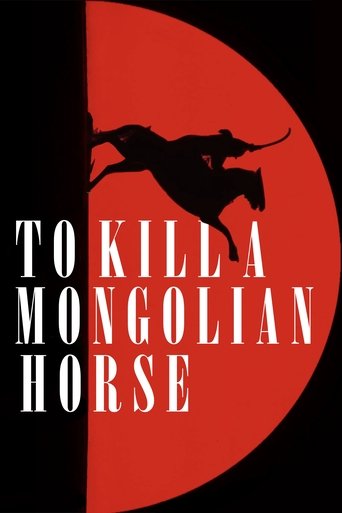
To Kill a Mongolian Horse (2025)
一匹白馬的熱夢
Amid the wintry steppes, Saina, a Mongolian horseman turned cultural performer, tends his ranch during the day and performs horseback tricks for audiences at night. Unlike the majestic cavalryman he portrays in the show, Saina discovers that his herdsman’s life is on the verge of disintegration.
- Date of release
- 2025-07-24
- TMDB
- 8.8 / 10 (5)
- Runtime
- 1h 37m
- Genres
- Drama
- Director
- Xiaoxuan Jiang
Casting
Interesting facts
To Kill a Mongolian Horse is a 2024 drama film directed and written by Jiang Xiaoxuan in her feature film debut. Set in Inner Mongolia and produced by Da Huang Pictures, the film is a co-production between Malaysia, Hong Kong, South Korea, Japan, and the United States. It stars Saina, a horseback performer and first-time actor, playing himself, and explores his struggle between adhering to traditions as a horseback performer and embracing contemporary society.
Production
Director Jiang Xiaoxuan grew up in Baotou, Inner Mongolia, where her father was a horse breeder. After graduating from the New York University Tisch School of the Arts, Jiang began working on her debut film, setting it against her upbringing and reflecting on the integral role of horses in Inner Mongolian culture.
The film was presented at the Asian Project Market in October 2023, where it won the VIPO Award and the Sørfond Award, as well as at the Hong Kong-Asia Film Financing Forum in March 2024. With a total budget of USD$320,000, Jiang explained that they did not deliberately join many project markets, attending only a few that were convenient in terms of timing, describing the funding they managed to secure as "a matter of luck".
Principal photography lasted about twenty days, with Tao Kio Qiu serving as the cinematographer, having previously collaborated with Jiang on her short film Graveyard of Horses (2022). Several crew members from Graveyard of Horses also reunited, including editor Zhong Zheng and the sound designer. Most of the shooting took place outdoors, utilizing drones.
The film features six horseback performance scenes intertwined with the dramatic narrative, with Jiang noting that these scenes serve both to demonstrate horsemanship skills and to advance the story. She views horseback performances as an art form that can resonate with audiences and aimed to convey subjective emotions, rather than presenting them objectively or anthropologically.
Read on Wikipedia · Text from Wikipedia, CC BY-SA 4.0. Data from Wikidata.
Recommended
- I Believe in Unicorns 2015 · ★ 6.6
- Here 2024 · ★ 6.5
- Resurrecting the Champ 2007 · ★ 6.3
- The Color of Friendship 2000 · ★ 6.7
- All About Ah-Long 1989 · ★ 7.4
- Skin 2009 · ★ 6.4
- Flicka 2006 · ★ 6.9
- Tigertail 2020 · ★ 6.7
- The Sound of Silence 2019 · ★ 5.9
- Home 2021 · ★ 6.7
- TalhotBlond 2012 · ★ 6.3
- Fast Girls 2012 · ★ 6.0